An Official Japan Heritage Site; Experience Beautiful Views and a Culture of Stone on Kitagishima Island
In the Southwest corner of Okayama Prefecture lie the Kasaoka Islands, the largest of which is called Kitagishima. Known since ancient times as a source of high-quality granite, the island is now registered as an official Japan Heritage site, as one of the “Islands of Stone.”

Written by
Okayama Prefecture is located in the Center of Western Japan and is known as the "Land of Sunshine" due to its warm climate and little rain throughout the year. It's conveniently located halfway between famous tourist destinations like Kyoto, Osaka, and Hiroshima! It's also the gateway to Shikoku via the Seto. Okayama is also known as the "Fruit Okayama," and the fruits that are sun-drenched in the warm climate of the Setouchi are of the highest quality in terms of sweetness, aroma, and flavor. You can enjoy seasonal fruits such as white peaches, Muscat grapes, and Pione grapes! Okayama is also home to world-class tourist spots, including Okayama Castle, Okayama Korakuen Garden, one of Japan's three most famous gardens, and Kurashiki Bikan Historical Quarter, which boasts history, culture, and art!
This service includes sponsored advertisements.
Only an hour away from the mainland by ferry, you can take in the beautiful scenery of the Seto Inland Sea on your way. A museum of the island’s stonecutting history, photogenic island dining, awe-inspiring views of the old quarries and the surrounding sea; Kitagishima has been drawing both domestic and international attention in recent years for its many charms as a tourist site.
This time, JAL Hometown Ambassador* (for Okayama Prefecture) Miki Shimoda and Stanford University MBA student Monica Malone, together with two coordinators for international relations working for Okayama Prefecture (Curran Stark and Karolina Wasilewska) experienced those charms first-hand.
*An initiative where flight attendants relocate to regions they have ties with, where they create products and tours utilizing local resources, and propose plans to address regional challenges.
-
Table of Contents
- From Fushigoe Port to Kitagishima
- “Island of Stone”, Official Japan Heritage Site
- One-stop shop for a relaxing island experience! Tourism hub K’s LABO
- Learning about the history of the “Island of Stone” at the stone museum
- Photogenic and mouthwatering island curry using local ingredients♪
- Quarry rockfaces and still lakes come together in “Kitagi’s Guilin”
- Largest on the island! A beautiful lake rising out of the abandoned chouba
- Venetian landscape on the island?! A port made of stone offcuts
- A stunning viewpoint utilizing the island's only active quarry
- Breathtaking and thrilling scenery at the leg-shaking height of 60m!
- Hikari Theater; one of four former cinemas, showing the island’s golden age
- Picturesque scenery and the story of stonecutting on the “Island of Stone”, Kitagishima
From Fushigoe Port to Kitagishima
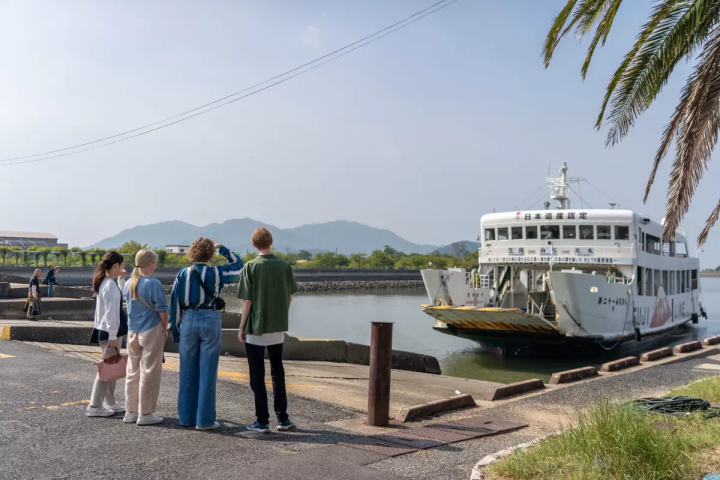
Their journey began at Fushigoe Port, a roughly 15 minute walk from JR Kasaoka Station.
There are two ways to reach Kitagishima, by ferry from Fushigoe Port or by passenger ship from Sumiyoshi Port.
The four travelers, excited for the day ahead, eagerly awaited the ferry’s arrival.
Fare for the ferry is paid onboard, so you won’t find tickets being sold at Fushigoe Port.

At last, it was time to board the ship. Miki had visited Hishima Island once before, so this was her second time visiting the Kasaoka Islands. However, for Monica this was going to be her first time visiting any island in Japan!
They were full of excitement and curiosity for the experiences awaiting them.
Shortly after getting on board, ferry staff came to take their fare. “It’s nice not having to wait in line!”, Monica remarked.
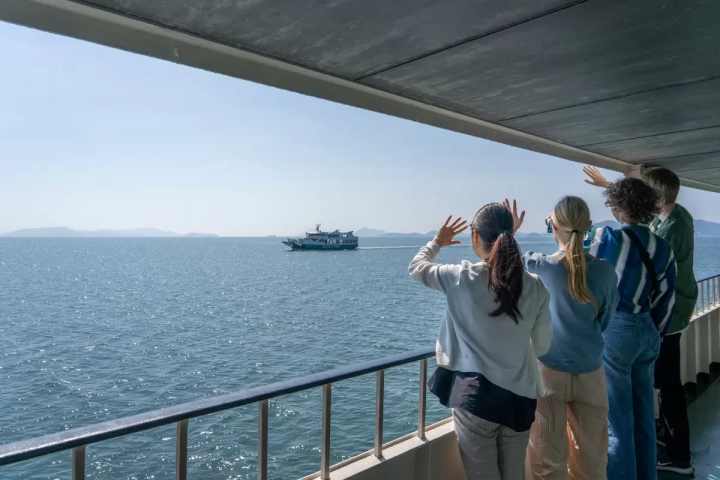
The boat proceeded smoothly along its route, aided by the nice weather. The ferry offers a rare chance to see views of not only the Kasaoka Islands, but islands all throughout the Seto Inland Sea. Out on the deck, the group had fun waving at passing ships and taking photos. Monica was used to seeing bare, rocky islands in other countries, so she was particularly drawn in by the lush greenery of the islands here in Japan.
After spending an hour on the gently rocking boat and passing by Shiraishijima Island on the way, the group finally arrived at Toyoura Port on Kitagishima.
“Island of Stone”, Official Japan Heritage Site
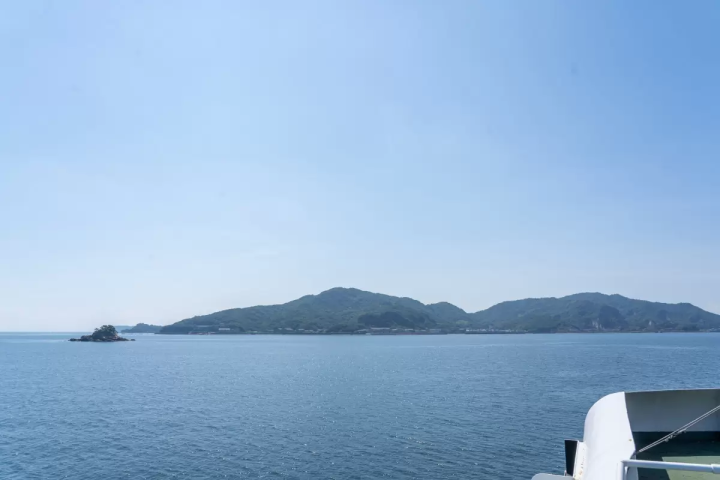
Kitagishima is well known as the source of “Kitagi Stone”, one of the three great stones from the Setouchi region. Due to the high quality of the stone, it has been used to build many famous pieces of architecture throughout Japan. Recognizing these achievements, the island was registered as an official Japan Heritage site under the title “Did you know!? The Islands of Stone where time flows immemorial―The Setouchi Bisan Islands that built the foundations of Japan from across the sea.” Today, these “Islands of Stone” are becoming more and more well known around the world.
One-stop shop for a relaxing island experience! Tourism hub K’s LABO
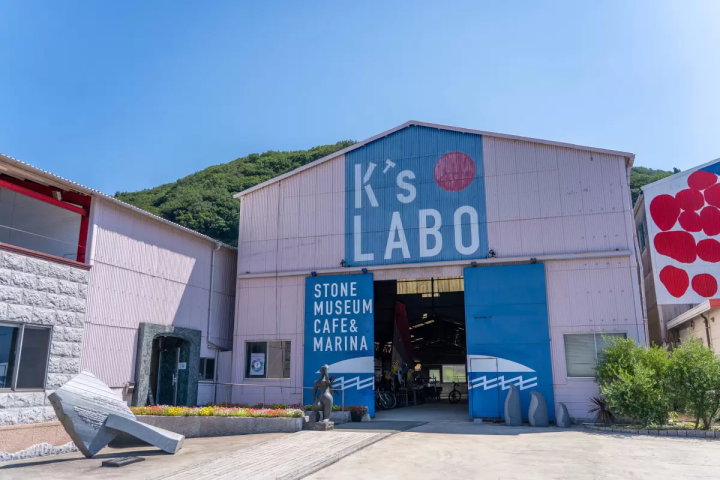
There are four ports on Kitagishima; Toyoura Port, Kanafuro Port, Ooura Port, and Kusunoki Port, but the majority of tourism sites are located in the area between Toyoura Port where the ferry stops, and Kanafuro Port. The group’s first destination was K’s LABO, a facility that acts as a hub for tourism on the island.
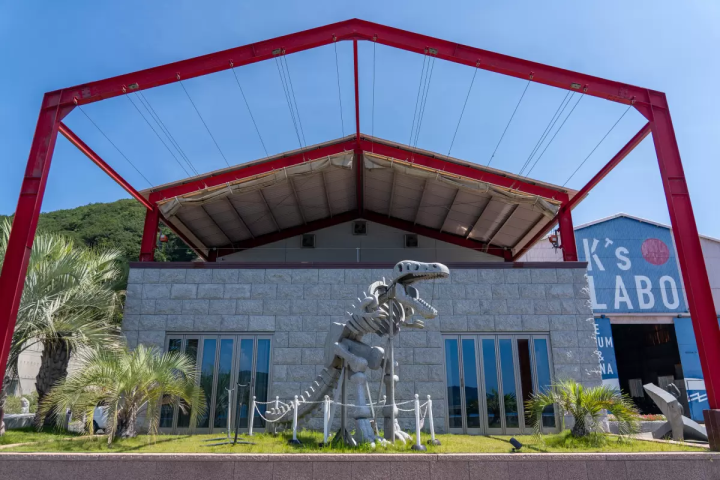
This combined facility was made by remodeling an old work site used by one of the island’s stone companies. Now it contains a stone museum where you can learn about the history of the stone industry on the island, as well as a café serving both food and drinks in a relaxing environment.
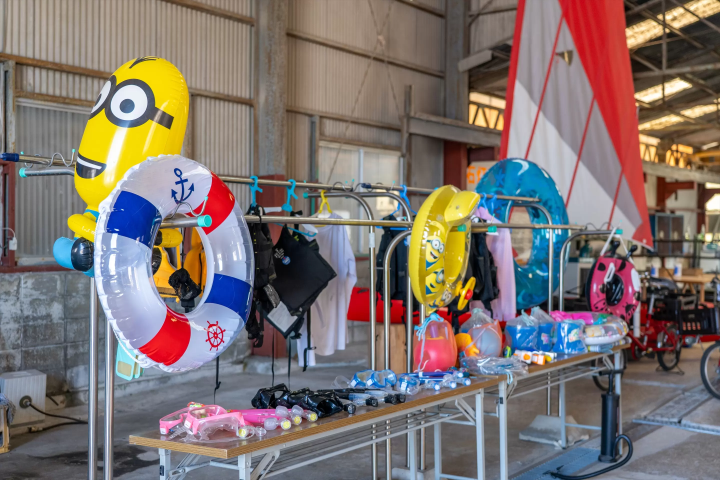
You can also rent the supplies you need to enjoy various activities on the island, including cycling, and marine sports like sea-kayaking and SUP.
Learning about the history of the “Island of Stone” at the stone museum
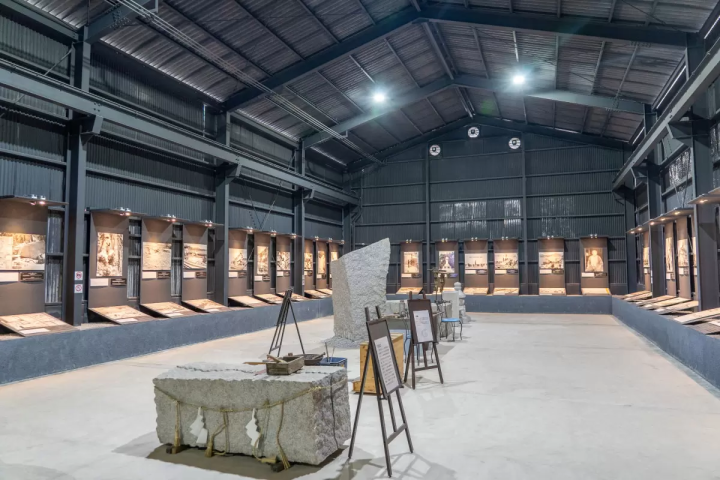
First off, the group went to learn about the history of the island’s quarries at the stone museum inside K’s LABO.

Guiding everyone on the island today was Mr. Sekitani, an employee from Tsuruta Stone, the last company to continueo perating quarries on Kitagishima to this day. The four visitors examined each exhibit panel attentively as they listened to Mr. Sekitani. After hearing that Kitagi Stone was used to build the walls of Osaka Castle, the Bank of Japan Headquarters, and other famous landmarks, Monica, intrigued, commented how she’d love to tour sites that used the stone in the future.
Photogenic and mouthwatering island curry using local ingredients♪
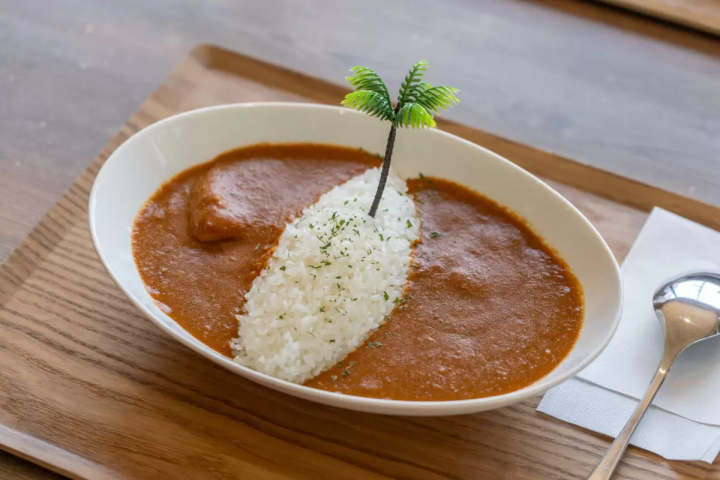
After the museum, it was time for lunch in the café. The stylish and open interior, with its view of the port and sea beyond, was perfect for a quick break on the island. The café, along with the terrace on the second floor, can also be rented out entirely. Soon after the group sat down, island-themed curry was brought out, each complete with a toy palm tree.
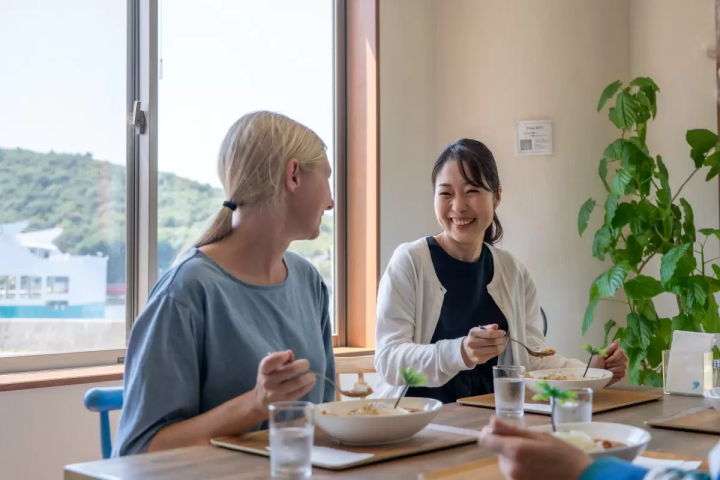
Following a resounding “Oooh!”, each member took their first bites of the curry and, eyes shining, remarked how delicious it was.
“The chicken is so tasty, as expected from Kasaoka raised chicken! The balance of spice in the curry is just right too.” Miki noted. Monica was also impressed, “I really like this curry! Japanese rice is so springy and delicious!”
K's LABO
 714-0301 10364-25 Kitagijima-cho, Kasaoka City, Okayama Prefecture
A complex facility located on Kitagijima in the Kasaoka Islands.
There is a ``Stone Museum'' that introduces the history, culture, and charm of stone, a ``Museum Shop'' that sells everything from stone miscellaneous goods to high-end stone products, and a cafe where you can enjoy leisurely island time while looking out at the islands of the Seto Inland Sea and the blue sky.
You can also try your hand at making stone lanterns, and rent bicycles and various marine leisure activities.
714-0301 10364-25 Kitagijima-cho, Kasaoka City, Okayama Prefecture
A complex facility located on Kitagijima in the Kasaoka Islands.
There is a ``Stone Museum'' that introduces the history, culture, and charm of stone, a ``Museum Shop'' that sells everything from stone miscellaneous goods to high-end stone products, and a cafe where you can enjoy leisurely island time while looking out at the islands of the Seto Inland Sea and the blue sky.
You can also try your hand at making stone lanterns, and rent bicycles and various marine leisure activities.
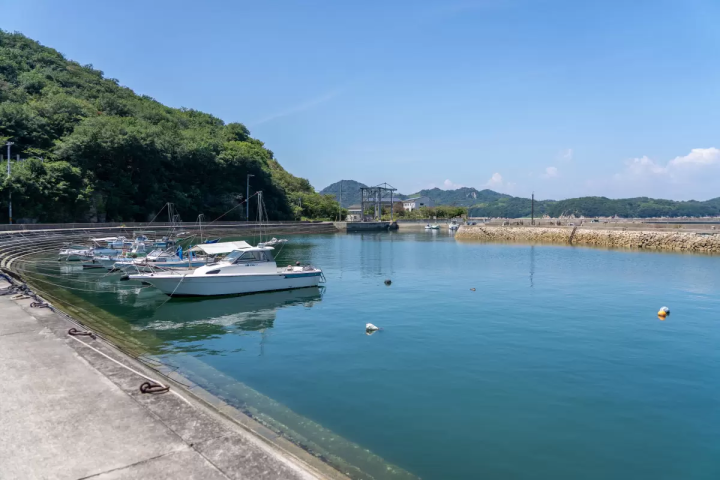
After filling up they set off for their next destination.
Since the island is surrounded by the sea, another charm of the island is being able to feel the sea breeze as you walk. Neighboring Shiraishijima island across the waves from Toyoura Port, the crystal-clear water along the coast, fish both large and small swimming nearby; there are plenty of sights you will only find at an island like this.
Quarry rockfaces and still lakes come together in “Kitagi’s Guilin”
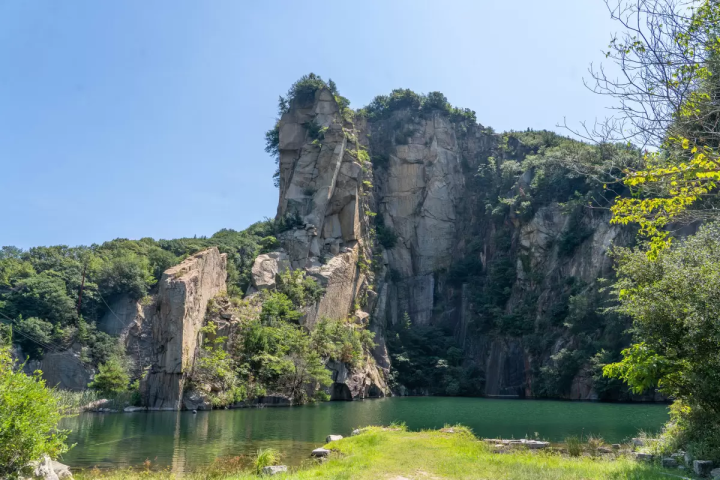
A 15 minute walk from K’s LABO, the next place Mr. Sekitani led them was the remains of a quarry, where rock was once cut out of the hills.
Since the stone was cut out in big, square blocks that resembled tofu, quarries are sometimes called chouba in Japanese, after the counting system for blocks of tofu: 1 chou, 2 chou, and so on.
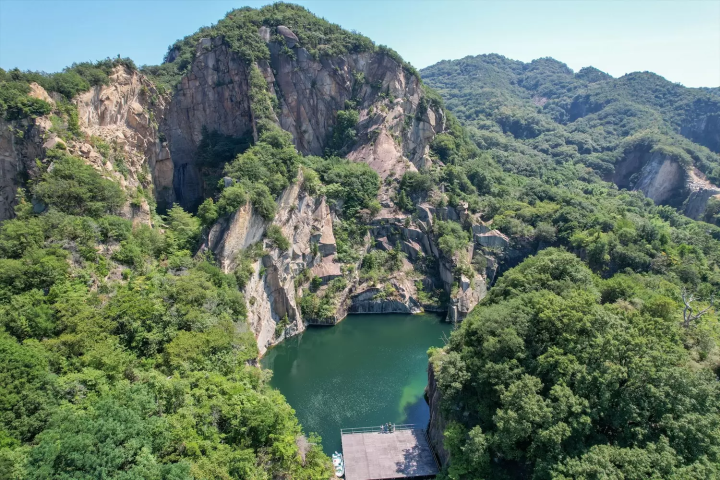
The exposed surface of the stone where the mountain had been shorn away made for an impressive sight. While quarrying hit its peak on the island in 1957, after that most of the stonecutting operations came to an end, and ultimately the abandoned quarries filled with rainwater and turned into lakes.
Due to its resemblance to the painting-like natural landscape of Guilin, China, the area has come to be called “Kitagi’s Guilin”.
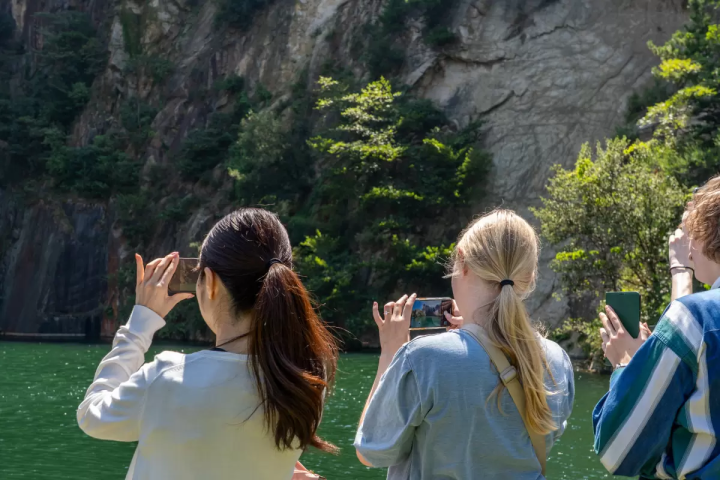
Miki and Monica instinctively pulled out their phones and began taking picture after picture, awestruck by the intense rockface and serene lake.
Largest on the island! A beautiful lake rising out of the abandoned chouba
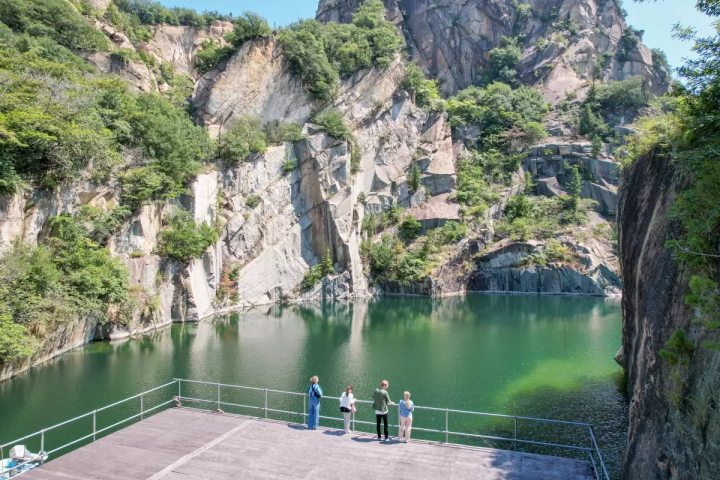
Next, the group visited the “chouba lake”, a short walk away from “Kitagi`s Guilin”. At the height of production, there were as many as 127 chouba (quarries) on Kitagishima, and this is said to be the largest of them all. As the group climbed the gentle slope, the beautiful emerald-green surface of the lake appeared a little further ahead, eliciting cries of “Wow!” from everyone. They enjoyed the view for a while from a stage made of old oyster-rafts set up on the lake. The surrounding area has been equipped with spectator seating made from leftover stone, and in recent years it has been used for events such as live concerts and fashion shows.
Venetian landscape on the island?! A port made of stone offcuts
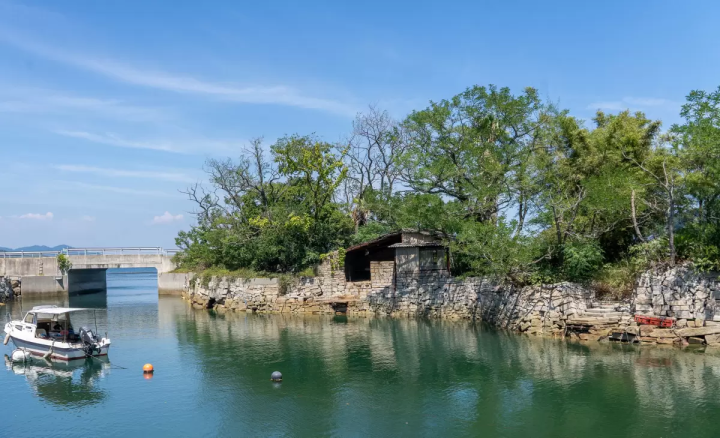
“Actually, we even have our own little Venice, ”said Mr. Sekitani. Intrigued by his words, the four headed to a small port known as “Kitagi's Venice.” Once used for shipping stone, the stone walls built by stacking quarry offcuts along the waterways evoke the scenery of Venice, which led to the nickname over time.
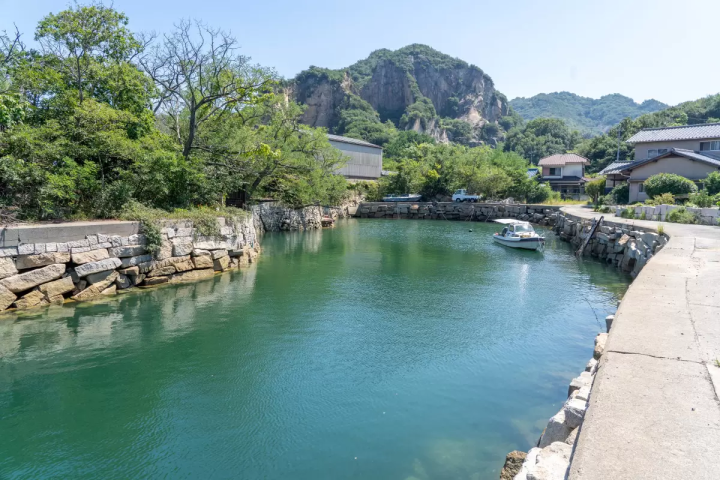
“It’s interesting to think that this landscape only exists because of the stonecutting history of the island. It even reminds me of the stonework in Machu Picchu a little,” commented Monica.
Miki also shared her thoughts, “It’s nice how you can really tell that uniquely Japanese stone working techniques, along with the culture of minimizing waste went into making this view.”
A stunning viewpoint utilizing the island's only active quarry
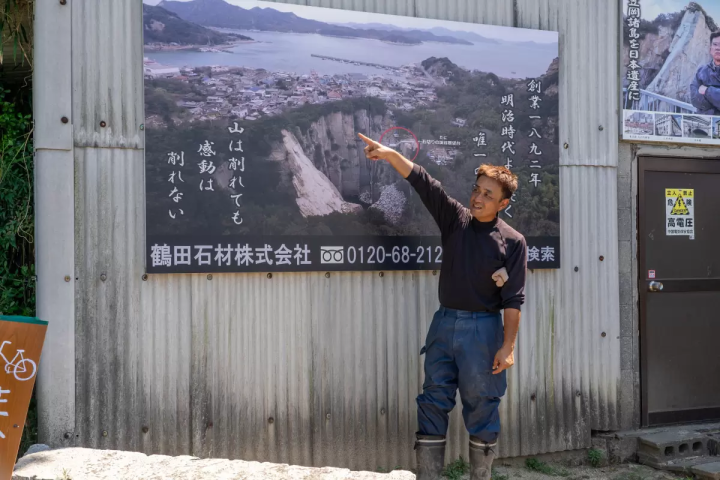
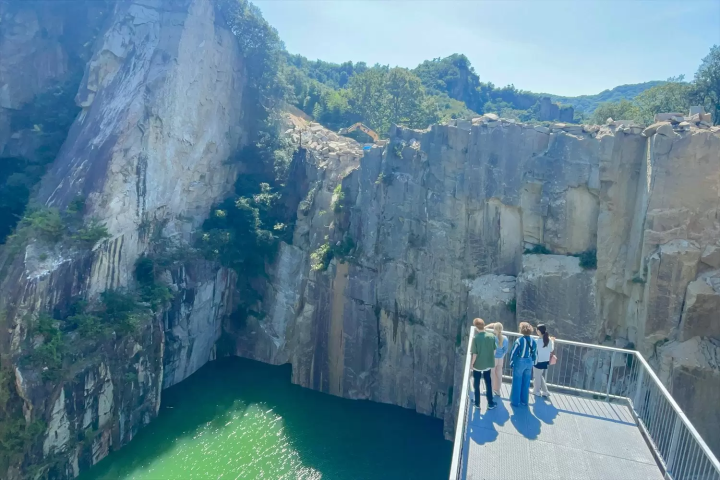
Next, the group visited the Stonecutting Valley Observation Deck, located in the only active quarry still in operation on the island. According to Mr. Sekitani, the company which manages this site, Tsuruta Stone, began quarrying here in 1892, digging down from the mountain top in search of high-quality stone. Over the long years, their work created sheer cliffs soaring 60 meters high, and so an observation deck was built to open up this awe-inspiring landscape to the public.
Visits are limited to 12:00 – 13:00 on weekdays, and 11:00 – 13:00 on weekends and holidays, but you can drop-in without prior reservation.
For group visits and visits outside of the specified times, please contact Tsuruta Stone in advance. (TEL: 0120-68-2120)
Breathtaking and thrilling scenery at the leg-shaking height of 60m!
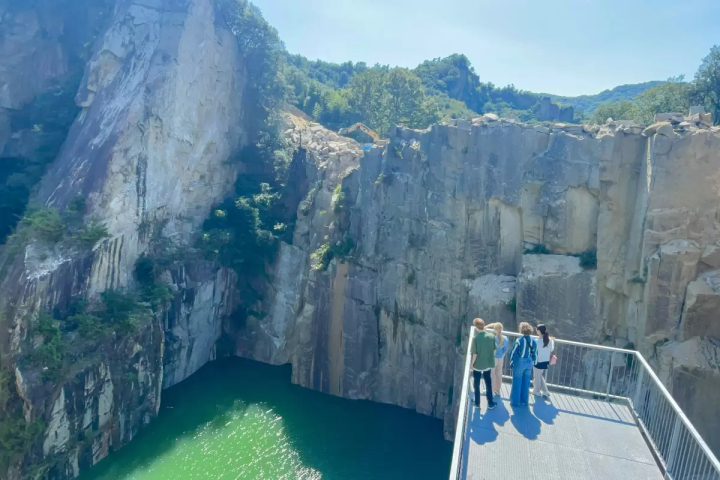
To reach the observation deck, the group followed the path alongside the reception area and climbed a fairly steep slope for about five minutes. At last, after reaching the top, a cliff of about 60 meters spread out before them. The thrilling height was enough to make the whole group freeze momentarily. But more than that, they were moved by the spectacular view created by the sheer cliffs and the emerald-green surface of the lake. They couldn't help but shout out “Hello!” and were pleased to hear the echo return their greetings.
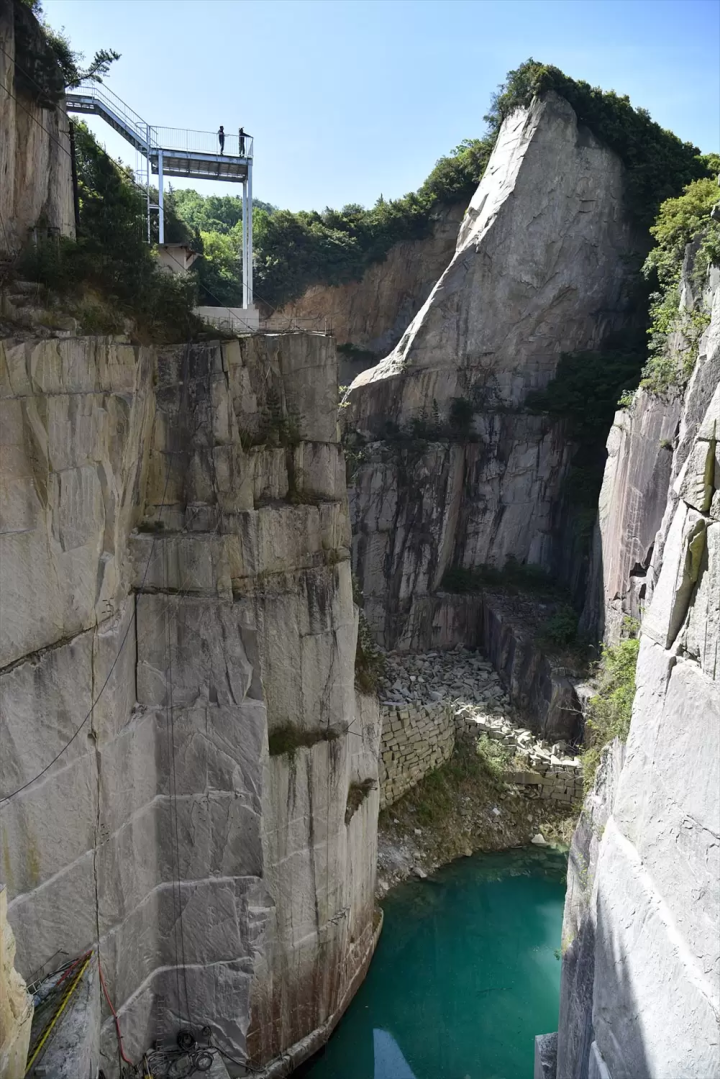
Looking out at the valley, Monica beamed, “I’m a bit scared of heights, but looking down at the quarry from high up is so thrilling! The pond spreading out below us is really beautiful.”
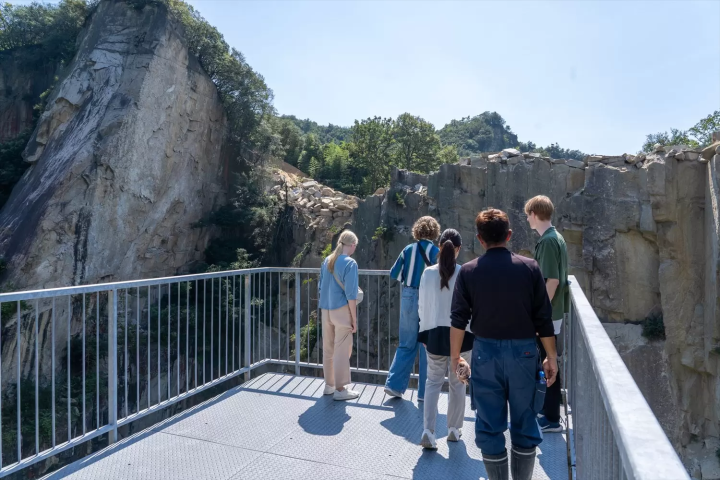
Miki also looked thoroughly satisfied, “I can’t imagine the precise skills needed to create cliffs cut in such a spectacular way! I also can’t help but look for bright red koi after hearing that people from the island released them in the lakes.” she laughed.
Hikari Theater; one of four former cinemas, showing the island’s golden age
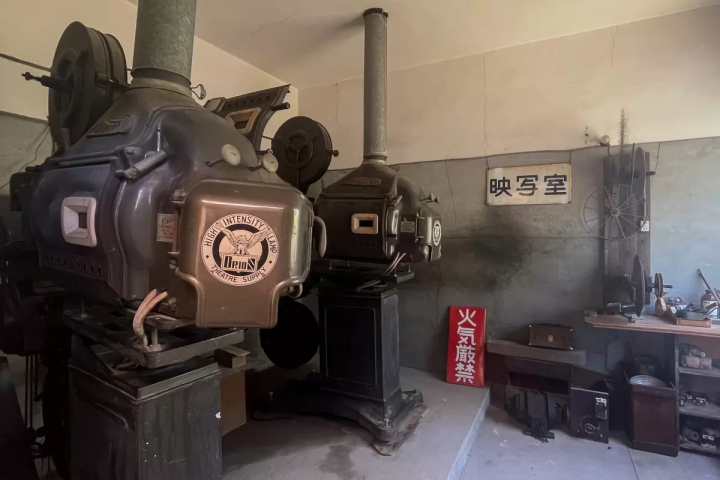
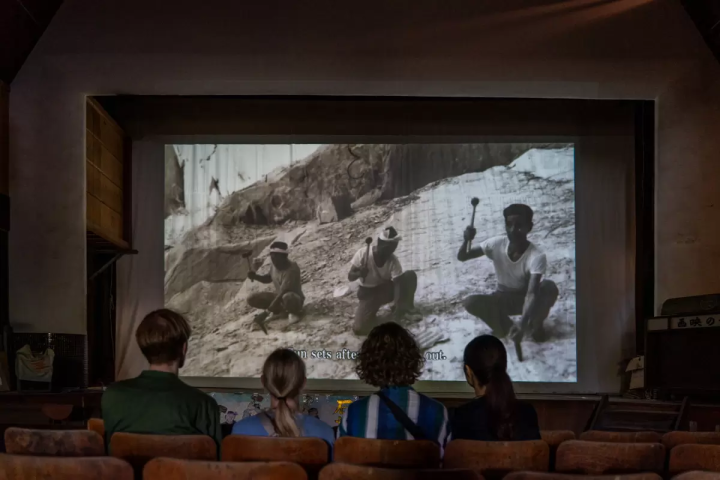
The trip was concluded with a visit to the former cinema, Hikari Theater. This cinema provided entertainment for the island's stonecutters during the 1940s to 1960s, when the stone industry was flourishing on Kitagishima. From a glance at the exterior, the cinema seemed like a normal house, but one step inside and into the small hall, they were greeted by a movie projector and other equipment from that age, still in their original state.
According to the theater manager, the island once had as many as four movie theaters. “It was even ahead of the mainland.” she said, conveying just how prosperous and thriving the island was at that time.
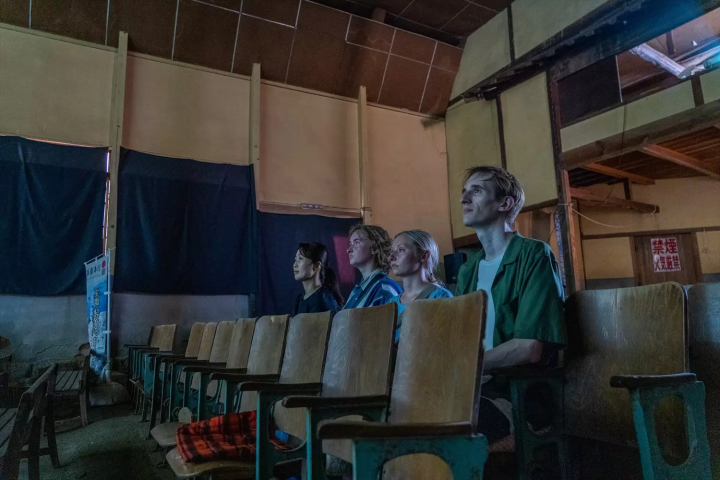
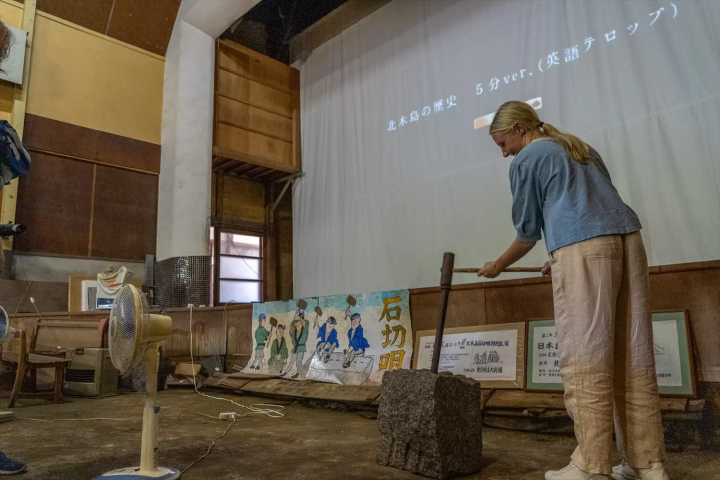
After watching a documentary about Kitagi stone (with English subtitles), the four participants had a chance to try their hands at stone splitting using a large hammer. They found themselves reflecting on the island's history and the memory of its former bustling days.
Though the Hikari Theater had once closed, a revitalization project launched about ten years ago successfully brought it back to life. It now serves as a vital hub for conveying the island's culture.
For tour inquiries, please contact the Friends Association in advance. (Contact: Mr. Umakoshi, TEL: 090-7893-8862)
Picturesque scenery and the story of stonecutting on the “Island of Stone”, Kitagishima
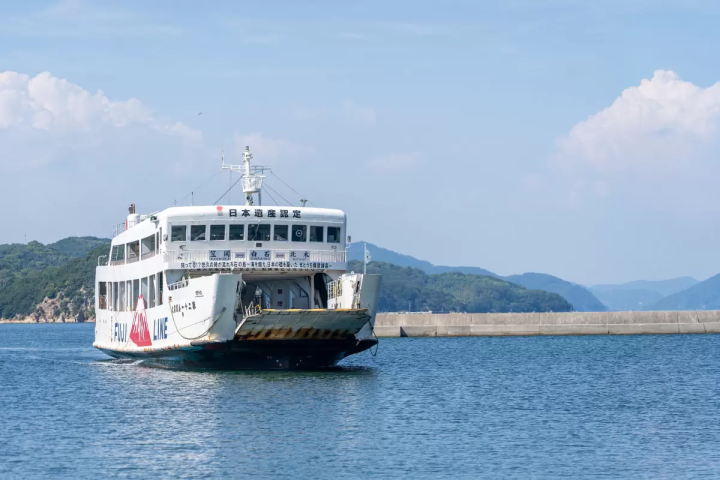
Before long, the group`s delightful time on the island drew to a close. For the return journey, they boarded the ferry at Kanafuro Port. Though only a half-day trip, it was filled with unexpected discoveries: the stunning beauty of the many Seto Inland Sea islands viewed from the ship, learning about the history of stone at the Stone Museum, savoring photogenic island cuisine, and touring breathtaking views and historic facilities connected to quarrying.
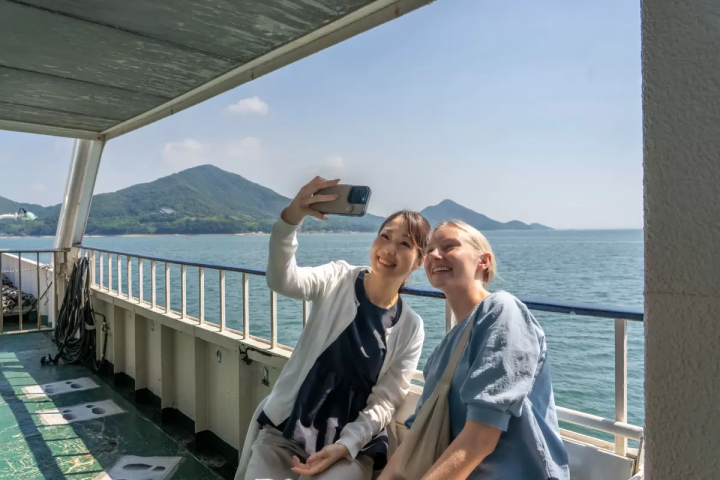
Lastly, Monica and Miki both shared their impressions.
“All of our experiences today were completely unique to the island. I always thought of Kyoto when it came to Japan's historical spots, but today I realized there's more to it than that. The movie theater we visited at the end was also wonderfully nostalgic.” (Monica)
“It was my first time visiting a quarry, but I was impressed by the awe-inspiring rockfaces and the beauty of the emerald-green lakes. All of the islanders we met were also incredibly warm and friendly.” (Miki)
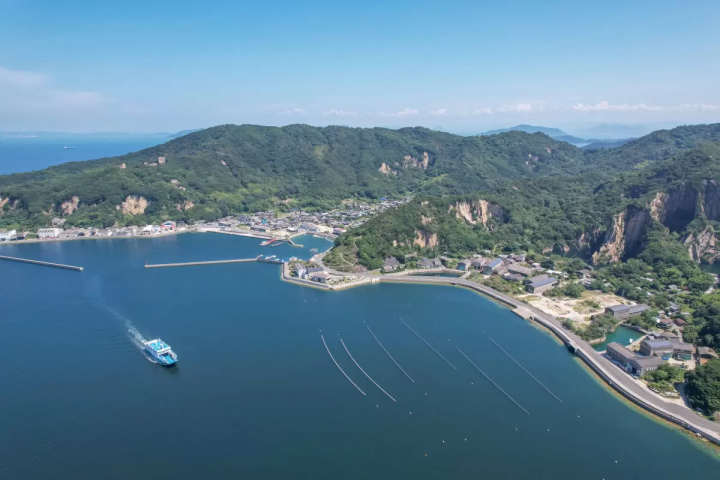
At its peak, Kitagishima Island was home to 6,000 people, but today its population is closer to 600. Yet the history left by its stonecutting culture and the magnificent landscapes of its quarry sites still live on as the island's treasures.
Quietly, but powerfully, stories of the past continue to echo throughout the Island of Stone. Why not go and listen?
Kitagishima Island
 714-0301 Kitagijima, Kasaoka City, Okayama Prefecture
It is the largest island in the Kasaoka Islands, located in the center of the Kasaoka Islands, approximately 26 km from Kasaoka Port. It has long been famous as a ``Stone Island'' known for ``Kitagi Granite,'' and during the construction of Osaka Castle in the early Edo period, large quantities of stone wall stone were sent there. After the Meiji era, stone mining became serious, and Kitagi stone was used in many buildings, including the Bank of Japan head office in Tokyo, the Mitsukoshi head office, Nihonbashi, and the Otorii gate of Yasukuni Shrine. Today, quarrying is still going on, and you can tour the quarry from the 60m-high "Ishikiri Valley Observation Deck" (for a fee). In 2019, it was designated as a Japanese Heritage Site as ``Did you know!? A stone island where eternity has passed - Setouchi Bisan Islands, which crossed the sea and built the foundation of Japan.''
714-0301 Kitagijima, Kasaoka City, Okayama Prefecture
It is the largest island in the Kasaoka Islands, located in the center of the Kasaoka Islands, approximately 26 km from Kasaoka Port. It has long been famous as a ``Stone Island'' known for ``Kitagi Granite,'' and during the construction of Osaka Castle in the early Edo period, large quantities of stone wall stone were sent there. After the Meiji era, stone mining became serious, and Kitagi stone was used in many buildings, including the Bank of Japan head office in Tokyo, the Mitsukoshi head office, Nihonbashi, and the Otorii gate of Yasukuni Shrine. Today, quarrying is still going on, and you can tour the quarry from the 60m-high "Ishikiri Valley Observation Deck" (for a fee). In 2019, it was designated as a Japanese Heritage Site as ``Did you know!? A stone island where eternity has passed - Setouchi Bisan Islands, which crossed the sea and built the foundation of Japan.''


![[Okayama ] UNESCO Intangible Cultural Heritage: Shiraishi Odori on Shiraishi Island in Kasaoka City](https://resources.matcha-jp.com/resize/200x2000/2024/07/22-188781.webp)
Okayama Prefecture is located in the Center of Western Japan and is known as the "Land of Sunshine" due to its warm climate and little rain throughout the year. It's conveniently located halfway between famous tourist destinations like Kyoto, Osaka, and Hiroshima! It's also the gateway to Shikoku via the Seto. Okayama is also known as the "Fruit Okayama," and the fruits that are sun-drenched in the warm climate of the Setouchi are of the highest quality in terms of sweetness, aroma, and flavor. You can enjoy seasonal fruits such as white peaches, Muscat grapes, and Pione grapes! Okayama is also home to world-class tourist spots, including Okayama Castle, Okayama Korakuen Garden, one of Japan's three most famous gardens, and Kurashiki Bikan Historical Quarter, which boasts history, culture, and art!
The contents on this page may partially contain automatic translation.
Special Features
More









![Enjoy popular spots in Okayama Prefecture with the great value digital travel ticket [Okayama Hare Tabi Passport]!](https://resources.matcha-jp.com/resize/720x2000/2025/04/28-232194.webp)