
The Meguro Residence, mansion of Uonuma City's most prominent wealthy farmer. It was actually a power spot too!
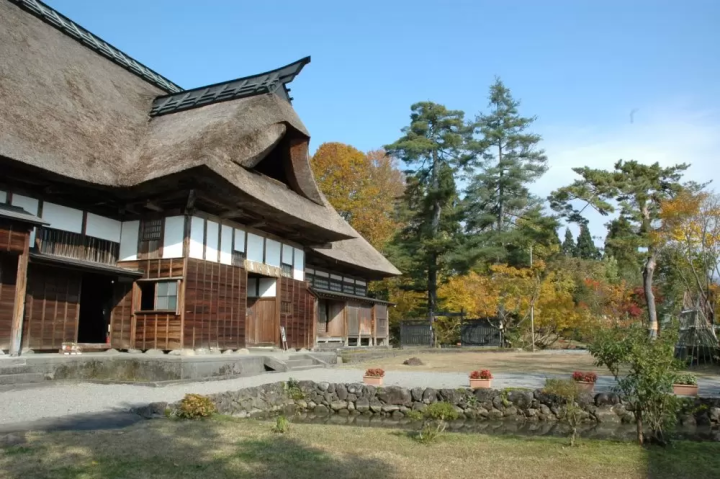
Autumn has arrived at Meguro Residence, and it is one of the best spots to enjoy the autumn leaves.

Written by
Uonuma City, located in southern Niigata Prefecture, is a town rich in nature at the foot of the Echigo Sanzan mountain range. Winter snow and spring meltwater irrigate the land, helping to cultivate delicious Uonuma koshihikari rice. Cherry blossoms and fresh greenery in spring, outdoor experiences in summer, golden rice fields and autumn leaves in autumn, and blankets of snow in winter. Every season offers stunning scenery that will make you want to take a photo. After your trip, take a relaxing dip in a hot spring. The flavors unique to a snowy country, such as freshly cooked koshihikari rice and wild vegetable dishes, will satisfy your soul. It's about two hours by Shinkansen from Tokyo. Why not take a leisurely trip to experience the warmth of nature and people?
This service includes sponsored advertisements.
Important Cultural Property Meguro Residence
It's a five-minute walk from Echigo-Suhara Station on the JR Tadami Tadami. The Meguro family, who once ruled the Suhara area of Uonuma City, now resides almost directly opposite the station, with the main house facing the Aizu Kaido. The Meguro family served as headman of the local government during the Edo period, and from the Meiji period onwards, they were promoters of regional modernization, making many contributions, including promoting industry, education, and culture, building roads, constructing railways, and constructing hydroelectric power plants.
This time, we experienced the history of the Meguro family through their mansion!
A wealthy farmer's mansion that withstood heavy snowfall and still retains its dignity
The Meguro family, descended from medieval samurai, is said to have returned to farming in what is now Suhara , Uonuma City, in 1590 (Tensho 18). In the mid-Edo period, in 1755 (Horeki 5), they were appointed as the head of the Itoigawa domain's Uonuma territory, and from then until the early Meiji period, successive generations of the family served as head village headmen. The current Meguro residence was built in 1797 (Kansei 9). Even now, more than 200 years later, it is a valuable building that still retains its original appearance.
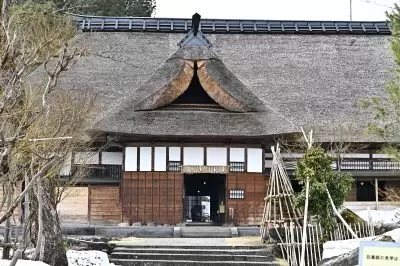
The first thing that catches your eye is the magnificent thatched roof and chidori gables on the front. The building has an area of 578.65㎡ (approximately 175 tsubo) and the land area is 6,253.12㎡, and its vast size suggests that it was one of the wealthiest farming families in Uonuma City. At its peak, a total of 20 people, including family members, servants, and apprentices, and two horses lived in the mansion.
Enter the mansion and feel like you've traveled back in time
The Meguro Residence actually has four entrances ! Starting from the left as you face the front of the building, there are "Servants," "Family/People on Business," "Head of the Family," and "Samurai/People of High Status." As you move to the right, your rank increases, and each person used their own designated entrance. Currently, visitors enter through the entrance that the "Head of the Family" used.
At the time of our visit, there was still snow remaining, so the area around the building and the garden were covered with snow fences. This arrangement is unique to areas with heavy snowfall. Entering the building from the bright outdoors, the interior is dim and cool, with the red-hot irori fire creating a truly magical atmosphere. Keeping the fire burning in the irori 365 days a year is very important for maintaining the mansion, and the tar contained in the smoke from burning firewood permeates the beams, thatched roof, and straw roofing materials, improving their insect and waterproofing properties . So the irori had an important role to play in addition to keeping warm and cooking.
In the same corner as the dirt floor, there is also the maid's room, the servants' bedroom called "kachiya," the "karyu-ba" (where food preparation and cooking were done), and the stables. The dirt floor was where the servants mainly lived.
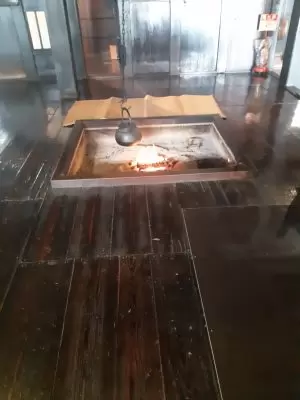
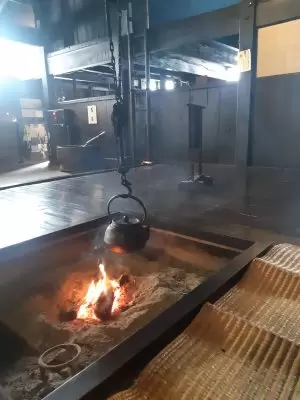
There is a high threshold between the dirt floor and the tea room. Once you cross the threshold and step into the tatami room, you can really get a feel for the class system of the Edo period.
Follow the route signs to proceed through the building.
It is said that the hall facing the front garden was once where the head clerk of the Meguro family worked. The Warimoto Shoya was what we would call a "government office" today. With this scene in mind, I proceed deeper into the tatami room.
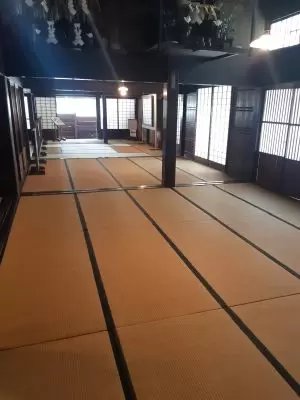
Next is the Spear Room, where as the name suggests, there is a "spear rack" attached to the ceiling. This is where the samurai would leave their spears that they carried (no spears are hanging there now). This veranda area was the entrance for people of high status, and at the time they would enter and exit with a basket parked next to them.
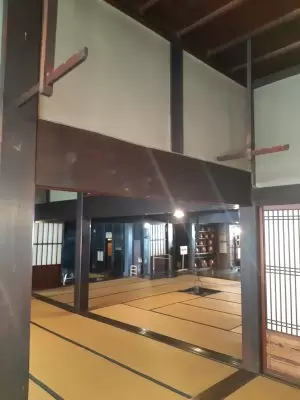
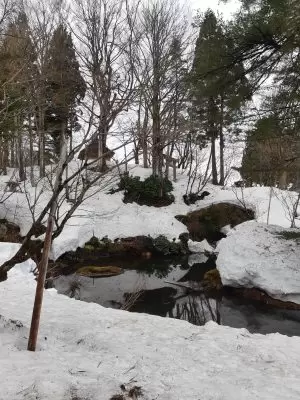
After passing through the middle room and Oku room, you come out onto a corridor facing the courtyard. Looking across the strolling garden with a pond, which is thought to have been built in the late Edo period, you can see the torii gates of Surugisha Shrine, the guardian deity of the Meguro family, and Inari Shrine on the hillside. As we visited in mid-March, we were able to see Surugisha Shrine and Inari Shrine's torii gate through the leafless winter trees. Sitting in the small room facing the courtyard and gazing at the garden, which changes with the seasons, people back then would have surely spent peaceful moments.
Further on, there are the inner bedroom and the new bedroom. The two rooms together are about 16 tatami mats in size, and at times were used as bedrooms by a family of 14 to 15 people. According to the person who was showing us around the building on the day of our visit, "It must have been a cramped sleeping area at the time."
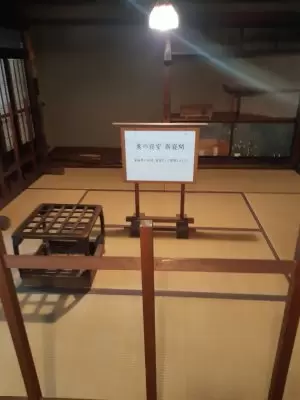
From the bedroom, turn left and proceed around the house.
This is a distribution board made in 1922.
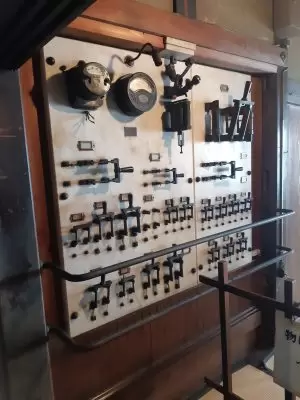
This switchboard is made in Germany and is made of marble.
Located about 1km from the Meguro residence, the Harama River, a first-class river in the Shinano River River system, has an abundant water volume typical of areas with heavy snowfall, and has long been attracting attention as a place for hydroelectric power generation. Later, with the increase in demand for electricity, the Suhara Power Station was built in 1913 (Taisho 2).
The Meguro family was ahead of its time and was one of the first to adopt electricity, installing streetlights around the mansion and giving back to the local community.
Incidentally, the Meguro family was also the first family in Niigata Prefecture to purchase a car. Perhaps they are actually quite an incredible family...
With the bedroom on your right, you circle the house and return to the first room, the living room. Beyond the living room lay the upper kitchen area, where meals for the family were prepared after ingredients were brought up from the lower kitchen area. Learning that the dining areas for the Meguro family and the servants were separate is fascinating as it gives you an idea of the hierarchy at the time. The space under the floor was used as a storehouse to store miso and other products.
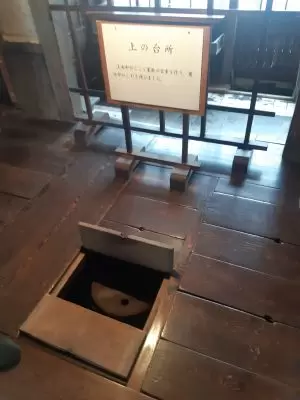
"Chotei" (Oak Residence) , the inner room of the detached house
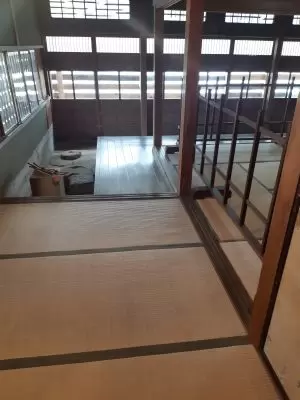
On the east side of the mansion is the Oak House, a two-story wooden detached tatami room built in the Sukiya-zukuri style, which was built in 1901 (Meiji 34).
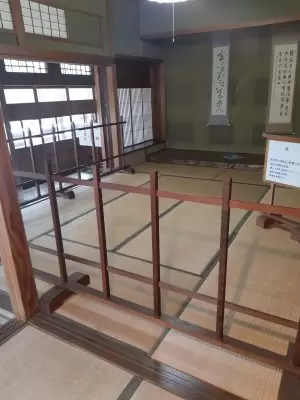
The inner sitting room of the detached building, named “Chotei” because a horse chestnut tree once stood there. Equipped with a tea room, a large dining room, a calligraphy room, and more, the building materials are made from fine wood from all over the country, and the dirt floor is also decorated with unusual stones that were once transported by Kitamaebune ships. At the time, waterways were more common than land routes, and goods from various regions were transported to this area by riverboat from the Sea of Japan to the Shinano River and Harama River. The fact that they collected goods from all over Japan gives us an idea of how the Meguro family lived at the time. The tea room, modeled after Ginkakuji Temple, and the alcove made from horse chestnut are also impressive. (At the time of the interview, entry to the Oak Residence was not permitted.)
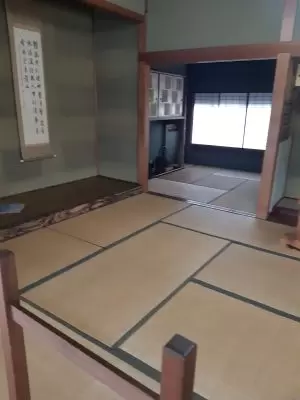
Power spot?! Anecdotes
There are signs of restoration all over the Meguro residence.
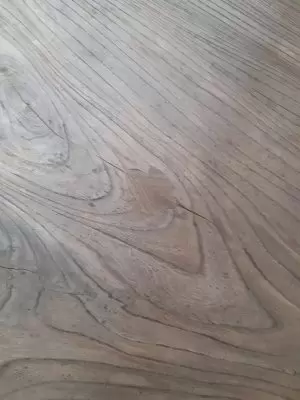
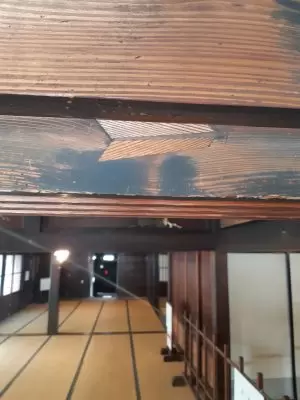
If you look closely at the restored pillars, floorboards, and other areas, you can see certain patterns. It's not just a matter of repairing, but the exquisite work of the craftsmen involved in the restoration is wonderful! The patterns include arrow feathers, which are considered to bring good luck. One way to enjoy the house is to walk around looking for how many there are.
Moreover!
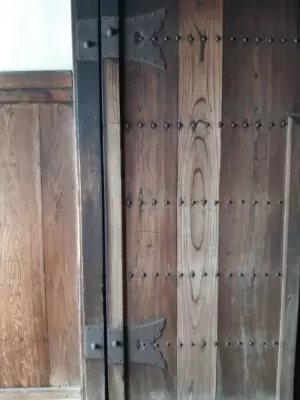
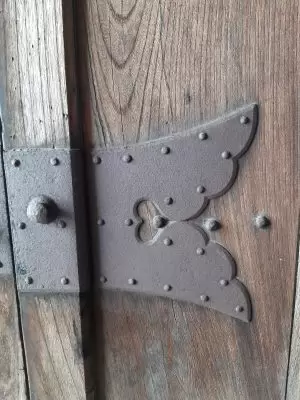
This is the "hasso kanagu" (eight-ply metal fittings) attached to the gate at the front entrance.
The shape is wide at the end, which is considered to be auspicious, and there is a heart ♥ mark in the center.
There is even one! It seems like something good will happen just by passing through the gate ♪
It was a hidden power spot known only to those in the know.
summary
Despite being located in the harsh conditions of a region with heavy snowfall, the "Wealthy Farmer's House" still retains its original appearance.
I imagine that a great deal of effort must have gone into preserving the original appearance of the building, from its magnificent beams and pillars to its thatched roof and garden on the premises. I hope that it will continue to convey the history of Uonuma City for 50 or 100 years to come.
Although we were unable to introduce it this time, the second floor of the building that houses the reception desk for the Meguro Residence tour is a cultural property museum, where old folk implements and other items are on display.
Additionally, the Meguro Residence Museum is located a 7-minute walk from the residence.
I recommend going through the backyard to get there ♪ There is a walking path so you can get there without getting lost.
The museum displays ancient documents and everyday items that have been passed down in the Meguro family since the early Edo period, as well as materials on the modernization of the region, allowing visitors to learn about the lives of wealthy farmers and the history of the people of Echigo Uonuma, a region with heavy snowfall.
| More Information | |
| TEL | 025-797-3220 (Meguro Residence Management Office) 025-795-5015 (Uonuma City Lifelong Learning Division, Cultural Properties Section) |
| address | 892 Suhara, Uonuma City, Niigata Prefecture, 946-0216 |
| Opening hours | 9:00 AM - 4:00 PM |
| Closed days | New year holiday season |
| Official website | https://www.city.uonuma.lg.jp/site/megurotei/ |
| parking | ⚪︎ Also available for large buses |
| Fee | Adults (high school students and above) | Children (elementary and junior high school students) | Groups (20 or more people) |
| Common (Meguro Residence, Folk Cultural Museum, Meguro Residence Archives) | ¥500 | ¥200 | Adults: ¥400, Children: ¥100 |
| Meguro Residence and Folk Cultural Museum | ¥400 | ¥200 | Adults: ¥300, Children: ¥100 |
| Meguro Residence Museum | ¥300 | Not for sale | Adults: ¥200 |
*Free for preschool children.
What did you think? The Uonuma City Tourism Association also provides other sightseeing and gourmet information on its official website. Please take a look at the official website!
Uonuma City, located in southern Niigata Prefecture, is a town rich in nature at the foot of the Echigo Sanzan mountain range. Winter snow and spring meltwater irrigate the land, helping to cultivate delicious Uonuma koshihikari rice. Cherry blossoms and fresh greenery in spring, outdoor experiences in summer, golden rice fields and autumn leaves in autumn, and blankets of snow in winter. Every season offers stunning scenery that will make you want to take a photo. After your trip, take a relaxing dip in a hot spring. The flavors unique to a snowy country, such as freshly cooked koshihikari rice and wild vegetable dishes, will satisfy your soul. It's about two hours by Shinkansen from Tokyo. Why not take a leisurely trip to experience the warmth of nature and people?
The contents on this page may partially contain automatic translation.


Special Features
More









![[Introducing our English Program] Experience English-language activities at KidZania Tokyo!](https://resources.matcha-jp.com/resize/720x2000/2026/05/19-264204.webp)

![Enjoy popular spots in Okayama Prefecture with the great value digital travel ticket [Okayama Hare Tabi Passport]!](https://resources.matcha-jp.com/resize/720x2000/2025/04/28-232194.webp)