
A fusion of Japanese and Western technology! Enjoy the World Heritage Tomioka Silk Mill, from an architectural perspective
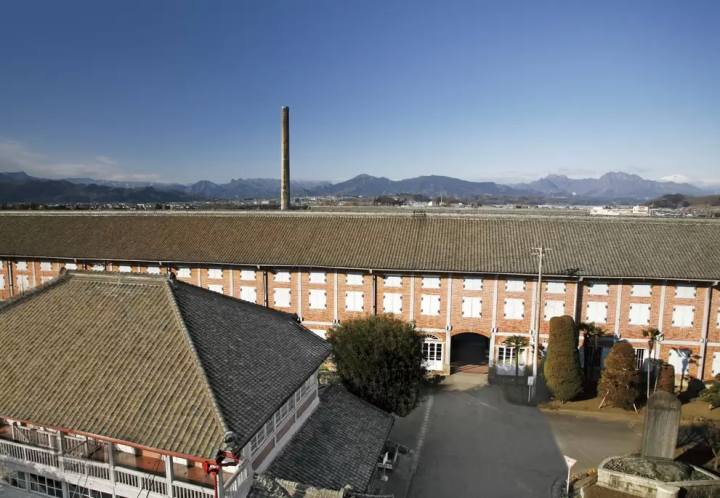
Tomioka Silk Mill is a World Heritage Site in Gunma Prefecture . Its timber-framed, brick-built architecture, a fusion of Japanese and Western techniques, is a must-see for architecture fans. Why not rediscover the charm of Tomioka Silk Mill not only from the perspective of industrial history, but also from the perspective of architecture?

Written by
The Tomioka City Tourism Association utilizes the tourism resources of Tomioka City, including the Tomioka Silk Mill and Mt. Myogi, in order to increase the number of visitors while contributing to the development of the local economy.
This service includes sponsored advertisements.
Tomioka Silk Mill, a World Heritage Site that combines Japanese and Western architectural techniques
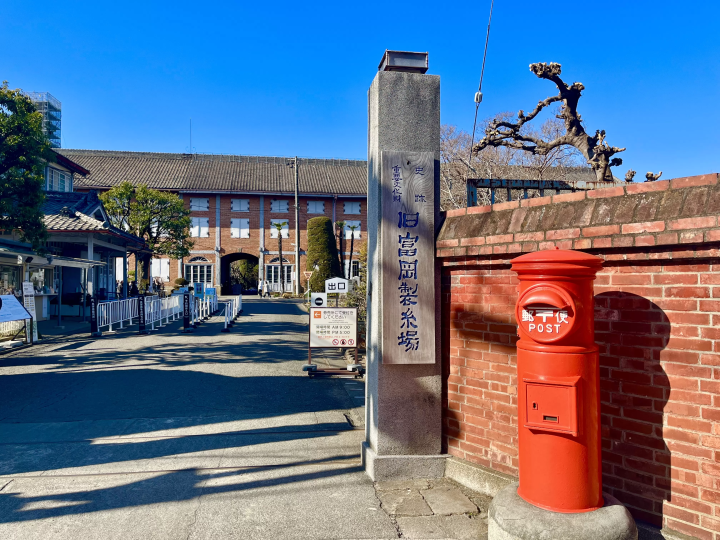
The Tomioka Silk Mill in Tomioka City, Gunma Prefecture , is Japan's first full-scale mechanized silk-reeling factory, founded in 1872. It was registered as a World Heritage Site in 2014 and has attracted attention from around the world as an industrial heritage site that symbolizes Japan's modernization.
However, the appeal of the Tomioka Silk Mill is not just its industrial history and history of raw silk production. The architecture, which combines Western architectural techniques with traditional Japanese techniques, is also worth seeing.
This building was built by Japanese craftsmen under the design guidance of a French engineer, employing the Western construction method of "timber-framed brick construction" while using Japanese roof tiles for the roof. It conveys to the present day the "challenges" of Meiji Japan.
In this article, we will take a closer look at the Tomioka Silk Mill from an architectural perspective and introduce the appeal of its main buildings.
Timber-framed brick construction seen in the East Cocoon Warehouse, the symbol of the Tomioka Silk Mill
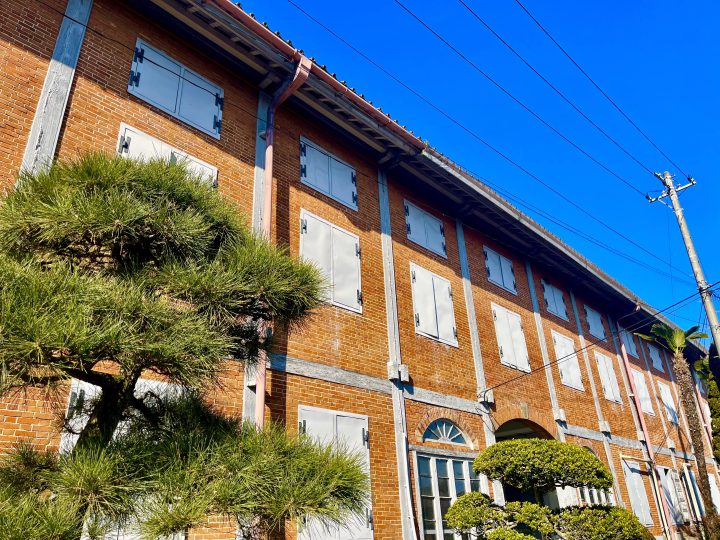
The first thing you see at Tomioka Silk Mill is the East Cocoon Warehouse, towering directly in front of the entrance. This huge cocoon warehouse, the face of the Tomioka Silk Mill , is the building that best illustrates the timber-framed brick construction .
Timber-framed brick construction is a construction method in which a wooden framework is assembled and bricks are laid between them to create walls. The weight of the building is supported by wooden pillars and beams, while the brick walls mainly serve as partitions and exteriors. It is a hybrid of Japanese and Western architecture, combining traditional Japanese wooden architecture with Western brickwork.
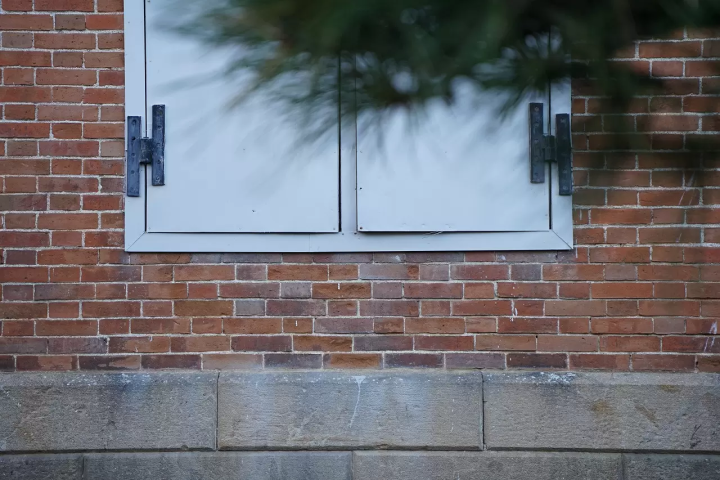
Take a look at how the bricks are laid. The main method used is "French bond," where the long and short sides of the bricks are alternately laid in the same row, but there are also some sections where "English bond," where rows of long and short sides are alternately stacked. The bricks were fired by tile craftsmen who were called in from Fukaya City , Saitama Prefecture . Under the guidance of French engineers, they completed a process of trial and error to create bricks specifically for the silk mill.
This is where Japanese craftsmanship and Western knowledge came together, and a new type of architecture was born.
Feel the power of a government-run silk factory at the Silk Reeling Plant factory
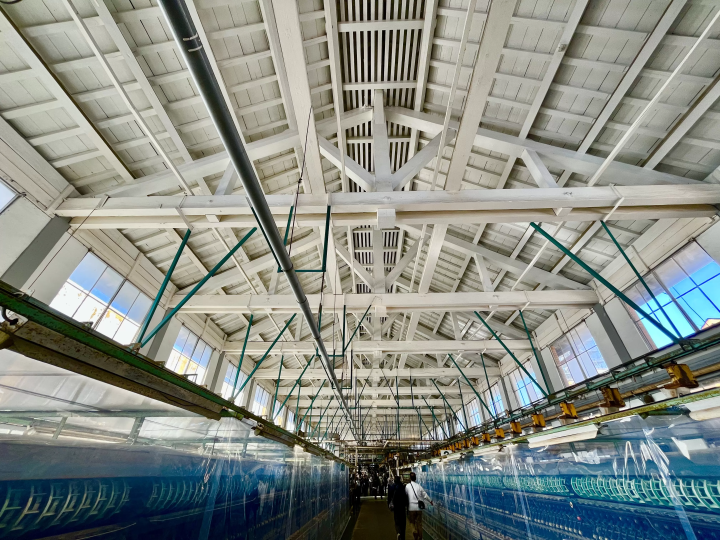
If you go further to the Oku of the East Cocoon Warehouse, you will arrive at the Silk Reeling Plant, which can be said to be the heart of the Tomioka Silk Mill . Like the East Cocoon Warehouse, it is a huge building made of timber and brick, measuring approximately 140 meters in length and 12 meters in width. In the past, there were as many as 300 silk reeling machines lined up here, and the female workers produced raw silk.
When you enter the building, the first thing that catches your eye is the ceiling. A truss structure has been used to create a large space without using pillars, and the wooden framework made up of interlocking triangles creates a beautiful geometric pattern. Looking at the spacious, pillar-free work space, it is easy to imagine that it must have been designed to allow 300 female workers to work efficiently.
The iron frames and glass of the windows, as well as the door hinges, were all imported from France, and it is clear that Western technology has been incorporated into every detail.
The silk-reeling machines used at the time of the shutdown are on display, allowing visitors to imagine the working conditions at the time. Standing in the spacious space and looking up at the ceiling, you can experience the power of the government-run silk factory that supported Japan's modernization.
The Chief's House is a colonial-style building adapted to the hot and humid environment.
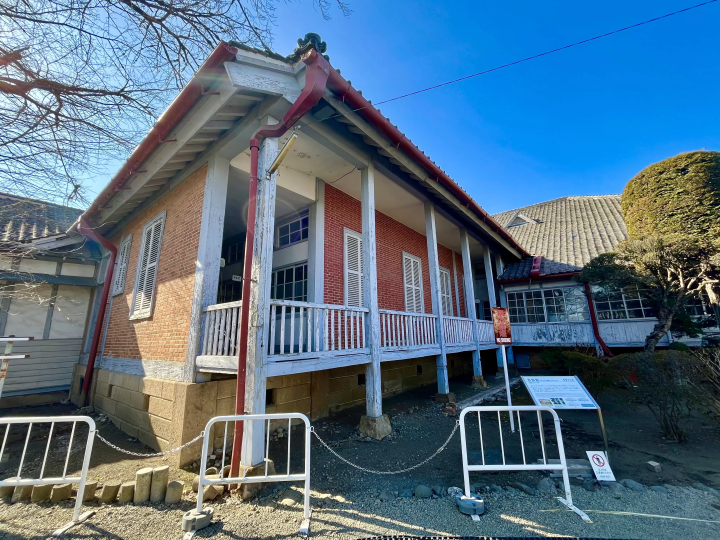
The silk mill grounds also contain the remains of the chief's mansion where French engineer Paul Brunat lived.
This building is characterized by its colonial style , which was seen in colonies of Britain, the Netherlands, Spain, and France during the colonial period. The verandas are arranged around the building, and are designed to protect it from high temperatures, humidity, and direct sunlight.
This colonial style is thought to have originated in the hot regions where Europeans had been advancing since the Age of Discovery, travelling around Africa to India, then through Southeast Asia to China and finally reaching Japan.
Meanwhile, the "Clapboard Colonials" that crossed the Atlantic Ocean from Britain and the American continent also reached Japan. Isn't it interesting that Japan was the final destination of their long journey that lasted for 400 years from the mid-15th century?
Furthermore, because the Chief's House was built later than the East Cocoon Warehouse, brickwork techniques have clearly evolved. The tile craftsmen must have gradually mastered the technique through trial and error under the guidance of French engineers. The brickwork at the East Cocoon Warehouse was uneven, but at the Chief's House it is neat and beautifully finished.
The Chochokan is perhaps one example of how Japanese craftsmanship and Western architectural styles are fused and further refined.
Also noteworthy is the West Cocoon Warehouse, which has made preservation and utilization possible using modern technology.
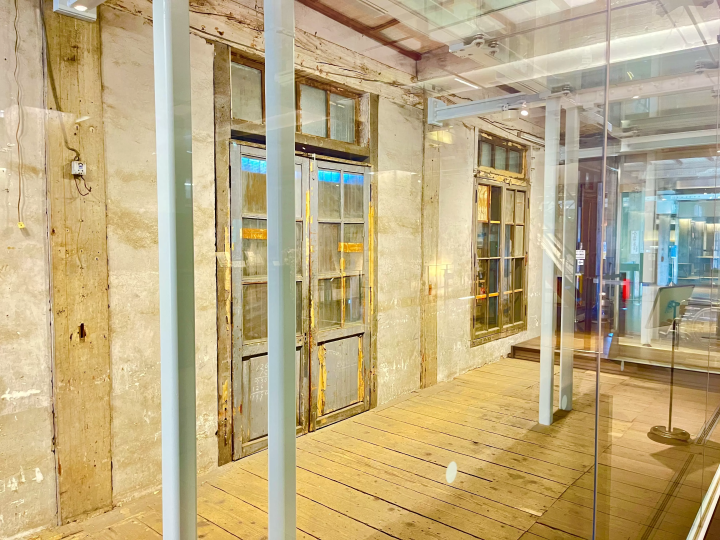
At the Tomioka Silk Mill, you can learn not only about the architectural techniques of the Meiji era, but also about modern preservation and utilization techniques. Inside the West Cocoon Warehouse building, there is an exhibition space enclosed in a glass box and a rest area.
The main purpose of these glass boxes is to reinforce the museum against earthquakes. Combined with a steel frame, they meet current earthquake resistance standards. At the same time, by separating visitors from the building, they also serve to protect the cultural assets from dirt, changes in humidity, and air conditioning.
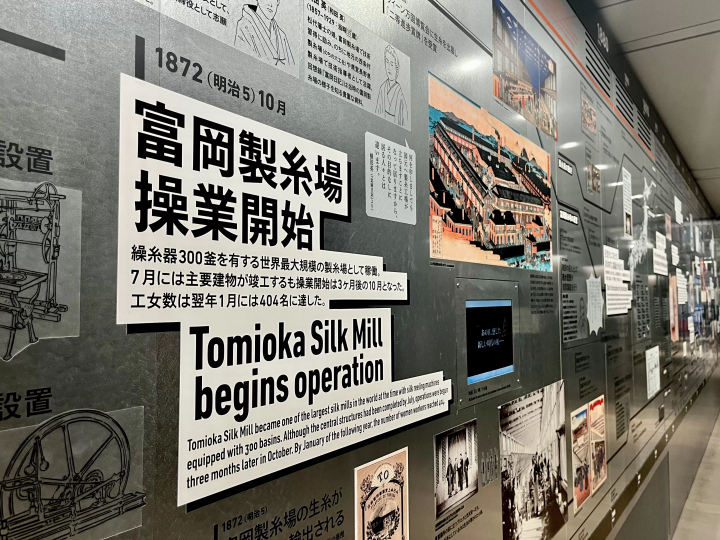
Also, noteworthy is the fact that the thinnest possible steel frame was used to avoid damaging the atmosphere of the national treasure.The timeline showing the history of the Tomioka Silk Mill, installed on the wall, is beautifully finished using photographs, documents, and videos.
This initiative, which won the Architectural Institute of Japan Award, may provide some clues for thinking about the future of historical buildings.
Summary: Tomioka Silk Mill where East and West meet modern technology
Tomioka Silk Mill, a model factory that supported Japan's modernization, is a place where traditional Japanese wooden construction techniques, Western brick, and architectural styles that have traveled from all over the world over the past 400 years come together and fuse together.
If you tour the building from an architectural perspective, you're sure to make new discoveries, from the beauty of the timber-framed brick construction, to traces of the craftsmen's trial and error, to modern preservation techniques.
The Tomioka City Tourism Association utilizes the tourism resources of Tomioka City, including the Tomioka Silk Mill and Mt. Myogi, in order to increase the number of visitors while contributing to the development of the local economy.
The contents on this page may partially contain automatic translation.


Special Features
More







![[Mie] TOBA SEASIDE HOTEL Dining Guide | Popular Buffet & Seasonal Menu Introduction](https://resources.matcha-jp.com/resize/720x2000/2026/05/11-263832.webp)
![[80 minutes by train from Kyoto ] Experience the countryside in Fukuchiyama City , Kyoto Prefecture , a special place only locals know about](https://resources.matcha-jp.com/resize/720x2000/2025/12/19-253414.webp)