
The Best Soy Sauce for Sushi! Visit Nakasada Shoten in Taketoyo

Taketoyo City is renowned for tamari, a rich and umami-packed soy sauce perfect for sushi and seafood dishes. Explore its production at Nakasada Shoten, a famous local maker.

Written by
Japan’s Fermentation: The Secret Behind UMAMI. Discover the hidden secrets and charms of Japan’s rich fermentation culture! Nagoya, once home to powerful shogun who shaped history, is famous for landmarks like Nagoya Castle and Ghibli Park. But did you know it's also a treasure trove of Japan’s iconic UMAMI-rich food culture? ■What's HAKKO? In Japanese cuisine, fermentation (HAKKO) plays a crucial role in creating flavorful seasonings and world-renowned sake. The mastery of fermentation techniques is key to crafting these delicious essentials. ■What Kind of Place is Nagoya? Located in central Japan, Nagoya serves as a major transportation hub, easily accessible by air and land. Thanks to its rich natural environment and unique climate, the region has cultivated a distinctive fermented food culture over the centuries.The Chita Peninsula, nestled between Ise Bay and Mikawa Bay, is a scenic region that has long been known for its thriving brewing industries, producing sake, vinegar, miso, and tamari soy sauce. Meanwhile, Nishi-Mikawa, the birthplace of Tokugawa Ieyasu, carries on the tradition of making Hatcho miso and the uniquely light-colored Shiro shoyu (white soy sauce)—both essential elements of Japanese cuisine.
This service includes sponsored advertisements.
The Rich Tamari Soy Sauce, a Specialty of Taketoyo City
The true highlight of exploring Aichi beyond Nagoya lies in the culinary discoveries that await at every corner. You'll stumble upon new fermented ingredients you never even knew existed! Think Hatcho Miso, a rich and distinctive soybean paste, or the delicate and versatile white soy sauce, both famous throughout Japan.
And speaking of soy sauce, prepare to be amazed by its diversity. Just a tiny tweak in how it's made or what goes into it can create an entirely different flavor profile.
This time, we're diving into tamari soy sauce – a distinct variety that connoisseurs often crown as the top choice for sushi and sashimi. To understand how this incredibly rich soy sauce is made, the ideal destination is Nakasada Shoten, a tamari soy sauce factory located in Taketoyo City.
Tamari Soy Sauce versus Regular Soy Sauce: The Difference Between Them
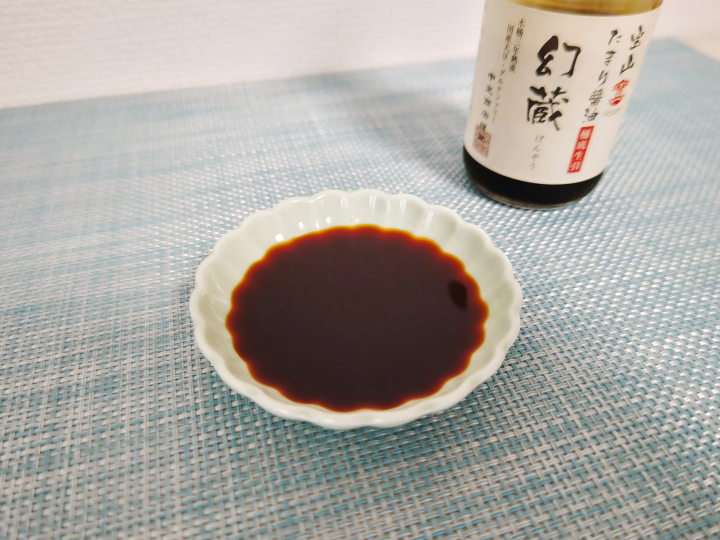
Before we delve into the charm of the Nakasada Shoten factory, let us quickly explain how tamari soy sauce differs from regular soy sauce.
The basic ingredients for common soy sauce are soybeans and wheat.These are made into koji mold, mixed with salted water and fermented for one year. The wheat is what gives the final product its distinct fragrance.
In contrast, tamari soy sauce is made using only soybeans and salted water. Steamed soybeans are formed into balls, inoculated with koji mold, and allowed to ferment for two days to create soybean koji. The mixture is then combined with salted water, placed in large wooden barrels, covered with river rocks, and left to ferment for three years.
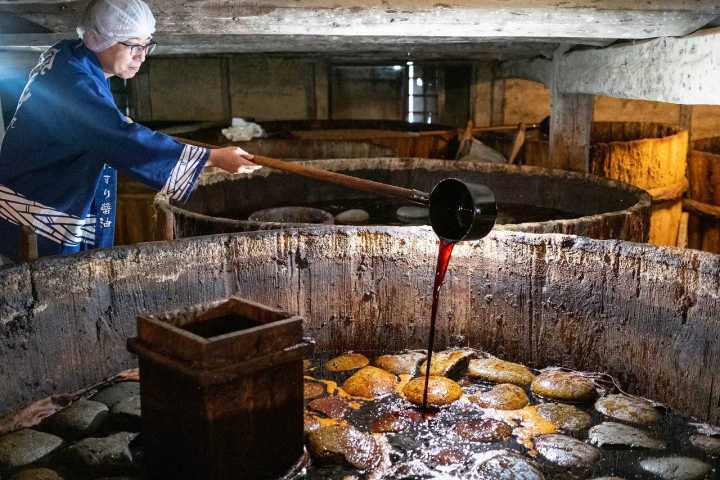
During this fermentation, the moromi (a mixture of soybean koji and salt water) is pressed under the weight of stones, causing liquid to seep out. This liquid collects in a tube with a hole at the bottom, which is placed inside the barrel. Using a ladle, the liquid is repeatedly poured back over the moromi from above the weights, as shown in the photo. This process is called Kumikake. This is performed about 40 times a day for each barrel, ensuring the liquid constantly circulates through the mash, which significantly enhances the flavor and richness of the final product.
In short, tamari soy sauce differs from regular soy sauce not only in its ingredients but also in its manufacturing process. This painstaking method makes tamari a rather rare and precious type of soy sauce. With a salt content of only 15%, its mellow flavor and rich umami perfectly enhance raw seafood, making it a great accompaniment to sushi, sashimi, and seafood bowls.
Nakasada Shoten: Making Excellent Miso and Soy Sauce Since 1879
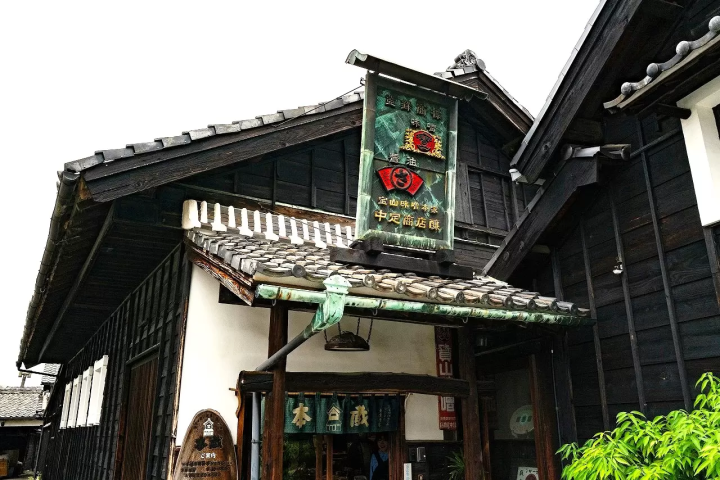
Nakasada Shoten's origins trace back to the early Meiji period (1868 - 1912). The region's expanding railway and port infrastructure at the time created a fertile environment for local manufacturers to flourish.
Believing the warm climate and pristine water would yield exceptional miso and tamari soy sauce, Nakagawa Sadahira established the first factory in 1879. Throughout the Taisho (1912 - 1923) and Showa (1926 - 1989) periods, the company consistently upheld high quality standards, solidifying Nakasada Shoten's reputation as a renowned brand.
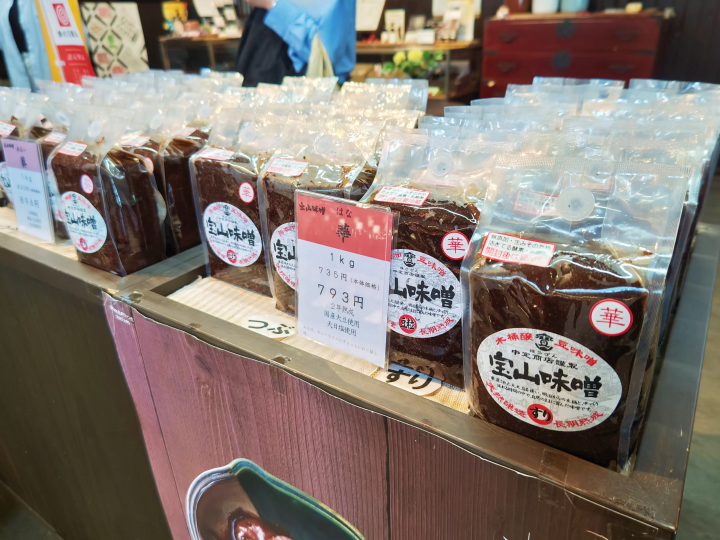
Since 2005, Nakasada Shoten has gained recognition for its miso paste cooking classes, offering valuable insights into miso's versatility. They've also received two excellence awards from the Director-General of the Food and Agricultural Materials Bureau, Ministry of Agriculture, Forestry and Fisheries.
A factory visit to Nakasada Shoten offers a chance to see tamari soy sauce being made and to marvel at rows of fragrant, wooden barrels of fermenting miso and soy sauce. You can also buy their soy sauce and miso products at the shop, plus snacks and cookies made with these ingredients.
Moreover, the Denshokan exhibition space at Nakasada Shoten showcases historical factory tools and artifacts. Here, you'll not only learn what makes tamari soy sauce unique but also appreciate the ingenuity of past generations of local makers.
Start Your Visit at the Denshokan with Historical Exhibits
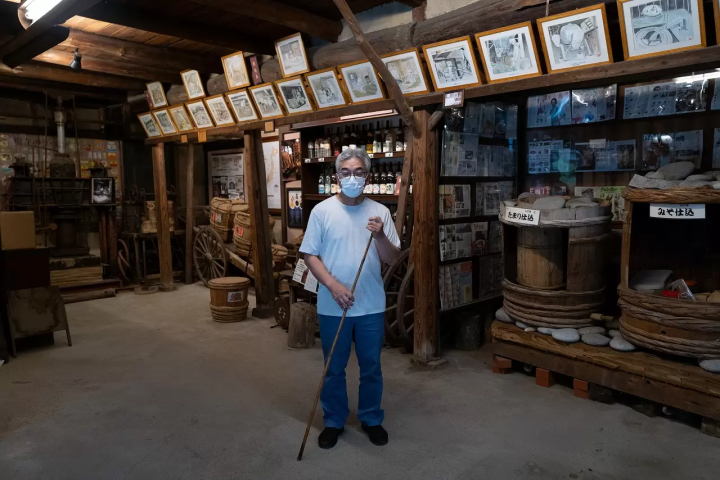
At the Denshokan, you'll find a fascinating collection of historical artifacts from Nakasada Shoten's past. Explore various utensils used in the factory, along with old photos, press clippings, and posters.
Original drawings by an artist friend of Mr. Nakagawa, the factory's president, visually explain the production process for both miso paste and tamari soy sauce made here.
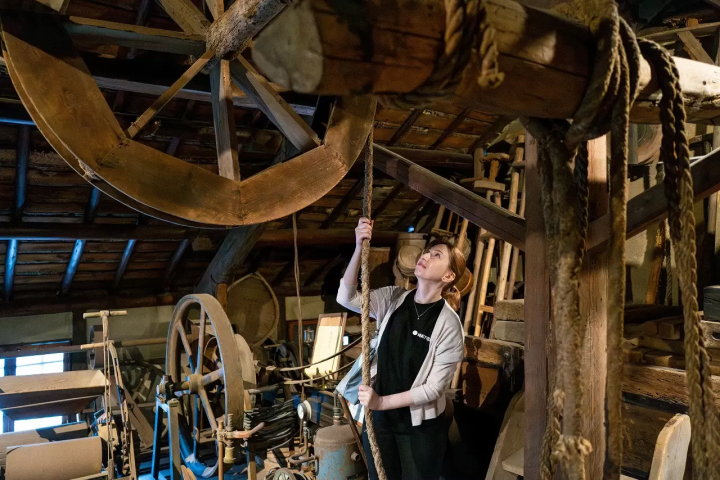
On the second floor, you can see other old utensils, including a wooden mechanism with attached rocks, once used to press tamari soy sauce liquid from miso paste. You can try pulling the weights yourself, guided by the staff, using a system of ropes and a suspended wheel.
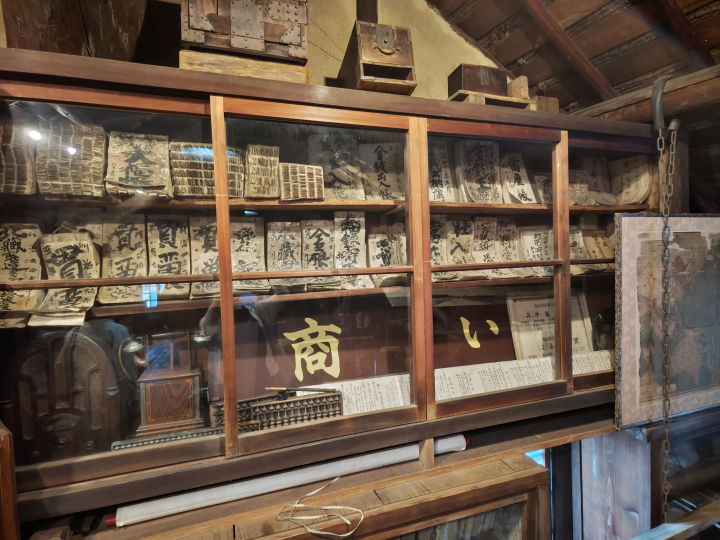
There are also old written records that were essential for tracking the business during the Meiji and Showa periods. The Denshokan truly offers a captivating look into Taketoyo’s rich fermentation traditions.
Factory Visit: Marvel at 150-Year-Old Wooden Barrels
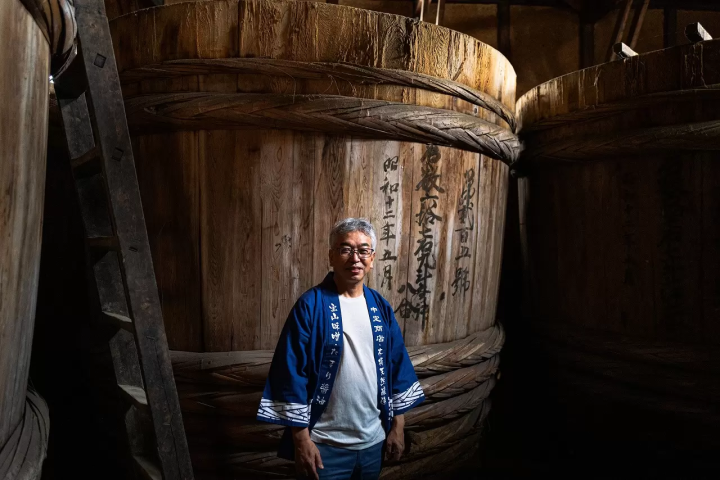
Like other fermentation facilities, Nakasada Shoten performs the initial steps of steaming and mixing ingredients with koji mold in a factory area closed to visitors. This measure minimizes the risk of dust and unwanted microorganisms affecting the fermentation process.
The only public area at the facility is the kura, where soy sauce and miso paste ferment in large containers. Stepping inside, you'll immediately notice the strong, rich aroma of miso and the sight of massive wooden containers in a semi-dark, mazelike space. Time feels slower here, and you'll find yourself lowering your voice, as if something vital were quietly maturing. After all, fermentation is a bacterial process, and in the kura, you can truly sense these microorganisms at work, slowly transforming simple mixtures into umami-rich ingredients.
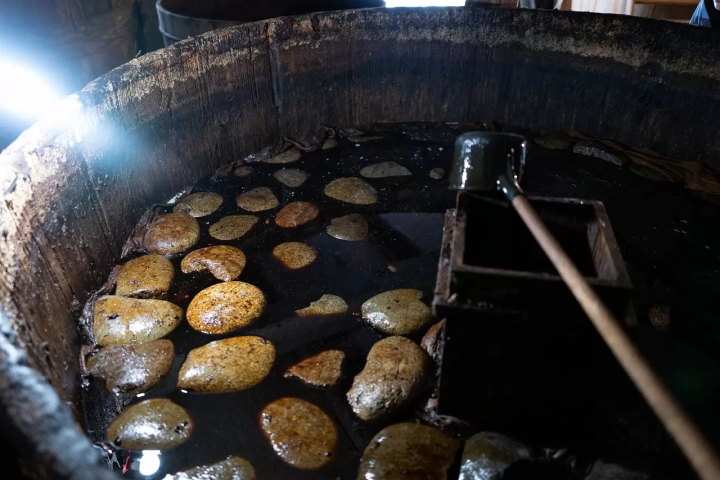
According to Mr. Nakagawa, the secret to the rich flavor of their tamari soy sauce and miso lies in these cypress barrels, which were inherited from sake breweries that used to operate in the region before the Meiji period.
Crafted through wooden joinery without any metal parts, these barrels provide an ideal environment for beneficial fermentation bacteria. That's why they're never fully replaced; instead, their surfaces are occasionally scraped and the barrels reassembled. Essentially, they are the same barrels used for 150 years.
While few carpenters still craft such barrels, they are crucial to the distinct flavor of the miso and tamari produced here. As Mr. Nakagawa explains, "Fermentation is all about collaborating with microorganisms."
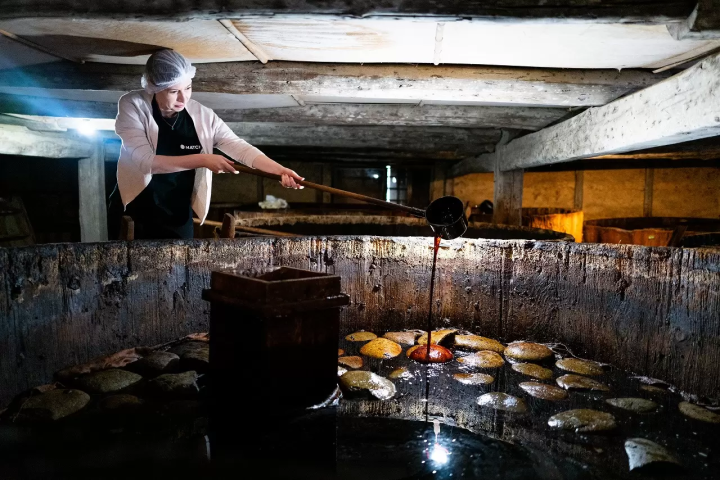
If you're visiting in a small group, you might get to try Kumikake, the process of scooping tamari soy sauce and pouring it back over the mash. Seeing the barrel's contents from above is quite impressive! All your senses will come alive: you'll smell the maturing soy sauce, hear its distinctive, rich sound, and feel the wooden ladle—the same tool professional tamari makers have used for generations. Kumikake is a truly special experience that will deepen your understanding of Japan's fermentation industry.
Visit the Shop for a Taste of Tamari Soy Sauce
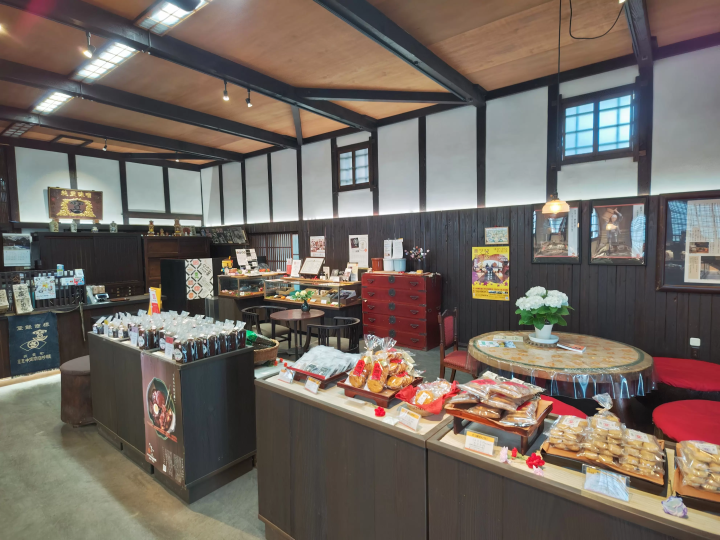
After visiting the kura (storehouse) and observing the tamari soy sauce maturation process, you'll surely want to taste it.
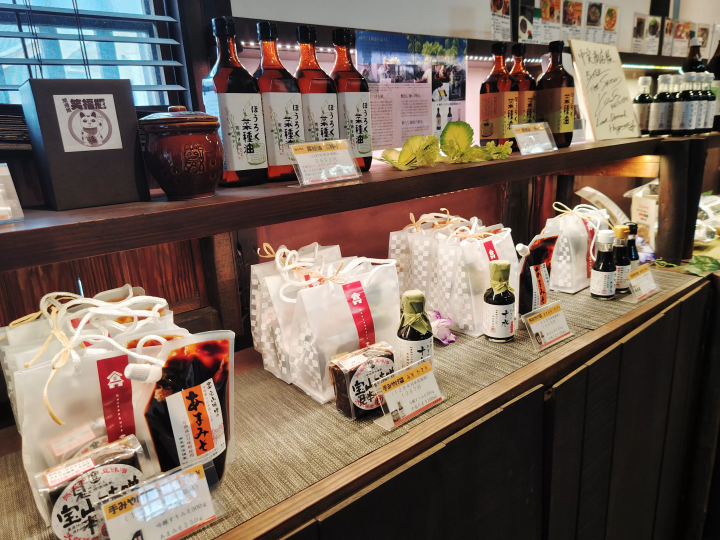
Be sure to stop by the Nakasada Shoten shop to find their complete line of tamari soy sauce and Hozan miso paste, plus a variety of snacks like cookies and rice crackers flavored with these unique ingredients.
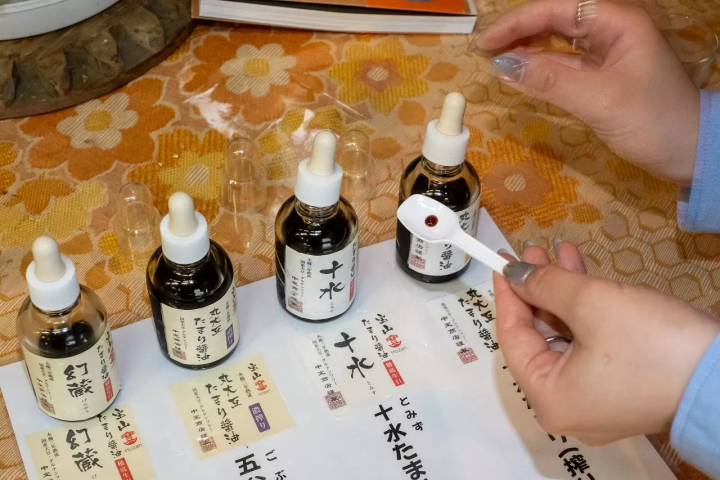
Don’t miss out on the tasting corner! Here, you can sample four distinct tamari soy sauces. It's an exciting opportunity to discover the subtle flavor variations and find your favorite.
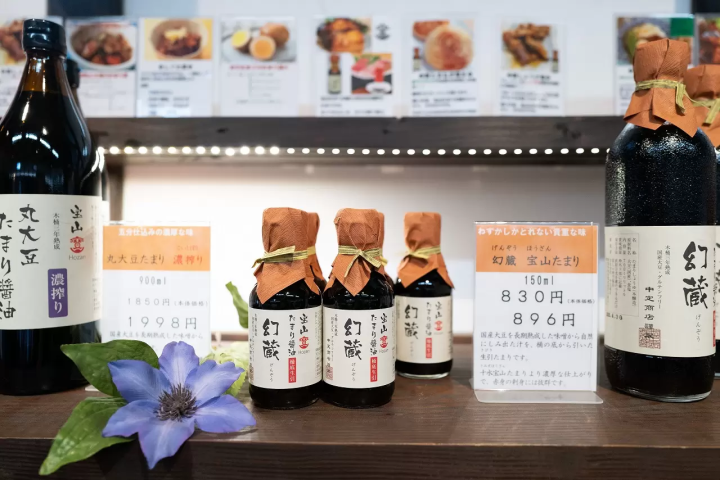
For the author of this article, discovering Genzo, the richest type of tamari soy sauce, was the highlight of her visit to Nakasada Shoten.
This rich, perfectly balanced soy sauce offers a delightful sweetness from its ingredients and is, in my opinion, the ideal complement for raw seafood like sushi and sashimi (especially with a touch of wasabi). While other soy sauces excel in simmered dishes, tamari truly shines with raw seafood. I hope your visit to Aichi sparks similarly transformative culinary insights!
Summary
Nakasada Shoten is conveniently located, just a 5-minute walk from JR Taketoyo Station, which you can reach in about an hour by train from both Nagoya Station and Central Japan International Airport, Nagoya (NGO).
Visit this facility to witness the making of the incredibly flavorful tamari soy sauce. Afterward, consider experiencing its culinary applications at local restaurants like Yutaka-Zushi, which is highlighted in our suggested Taketoyo itinerary (link here).
Nakasada Shoten
 51 Komukae, Taketoyocho, Chita, Aichi, 470-2343
This region, blessed with a warm climate and quality water, inspired a conviction that excellent miso and tamari could be produced using these resources. Thus, a miso and tamari brewery was founded in June 1879.
Tamari soy sauce is said to have originated from the liquid that seeped out during the soybean miso-making process, accumulating at the bottom of the barrel before being collected.
It can be considered the origin of soy sauce. Its characteristics include a lower salt content compared to other soy sauces and a rich, full-bodied flavor.
Since its main ingredient is soybeans, it is rich in protein and glutamic acid, an essential amino acid for the human body and a component of umami flavor.
Made with only domestic soybeans and salt, they have been producing traditional miso for 140 years. The brewery is committed to natural fermentation, drawing out a rich umami flavor through long-term aging without any unnecessary additives.
Miso-making classes and brewery festivals are also popular.
51 Komukae, Taketoyocho, Chita, Aichi, 470-2343
This region, blessed with a warm climate and quality water, inspired a conviction that excellent miso and tamari could be produced using these resources. Thus, a miso and tamari brewery was founded in June 1879.
Tamari soy sauce is said to have originated from the liquid that seeped out during the soybean miso-making process, accumulating at the bottom of the barrel before being collected.
It can be considered the origin of soy sauce. Its characteristics include a lower salt content compared to other soy sauces and a rich, full-bodied flavor.
Since its main ingredient is soybeans, it is rich in protein and glutamic acid, an essential amino acid for the human body and a component of umami flavor.
Made with only domestic soybeans and salt, they have been producing traditional miso for 140 years. The brewery is committed to natural fermentation, drawing out a rich umami flavor through long-term aging without any unnecessary additives.
Miso-making classes and brewery festivals are also popular.
Japan’s Fermentation: The Secret Behind UMAMI. Discover the hidden secrets and charms of Japan’s rich fermentation culture! Nagoya, once home to powerful shogun who shaped history, is famous for landmarks like Nagoya Castle and Ghibli Park. But did you know it's also a treasure trove of Japan’s iconic UMAMI-rich food culture? ■What's HAKKO? In Japanese cuisine, fermentation (HAKKO) plays a crucial role in creating flavorful seasonings and world-renowned sake. The mastery of fermentation techniques is key to crafting these delicious essentials. ■What Kind of Place is Nagoya? Located in central Japan, Nagoya serves as a major transportation hub, easily accessible by air and land. Thanks to its rich natural environment and unique climate, the region has cultivated a distinctive fermented food culture over the centuries.The Chita Peninsula, nestled between Ise Bay and Mikawa Bay, is a scenic region that has long been known for its thriving brewing industries, producing sake, vinegar, miso, and tamari soy sauce. Meanwhile, Nishi-Mikawa, the birthplace of Tokugawa Ieyasu, carries on the tradition of making Hatcho miso and the uniquely light-colored Shiro shoyu (white soy sauce)—both essential elements of Japanese cuisine.
The contents on this page may partially contain automatic translation.
Special Features
More







![[Mie] TOBA SEASIDE HOTEL Dining Guide | Popular Buffet & Seasonal Menu Introduction](https://resources.matcha-jp.com/resize/720x2000/2026/05/11-263832.webp)
![[80 minutes by train from Kyoto ] Experience the countryside in Fukuchiyama City , Kyoto Prefecture , a special place only locals know about](https://resources.matcha-jp.com/resize/720x2000/2025/12/19-253414.webp)