[ Tosashimizu City, Kochi Prefecture ] How to get to Izu Shrine and important points to note
![[ Tosashimizu City, Kochi Prefecture ] How to get to Izu Shrine and important points to note](https://resources.matcha-jp.com/resize/720x2000/2026/03/07-260531.webp)
Izu Shrine is a historic shrine, but it is a very difficult spot to access. I have actually visited it, so I will share detailed access information, my impressions on the site, and things to be aware of.

Written by
The Hata region of Kochi Prefecture is located at the southwestern tip of Shikoku, and is a peninsula that juts out into the Pacific Ocean, facing Tosa Bay to the east and Bungo Channel to the west. It is made up of three cities, two towns, and one village: Hara Village. It is a natural powerhouse rich in blessings, including the nationally famous Shimanto River and Cape Ashizuri, the blessings of the Kuroshio Current that flows along the coast, and the blessings of mountains that boast the largest area of forests in the country.
This service includes sponsored advertisements.
Introduction
Izu Shrine is listed in the Engishiki, a list of shrines that were officially recognized by the Imperial Court in the mid-Heian period, and has a history of at least 1,000 years.
Because it is located in a fairly remote area within Tosashimizu City, I had seen reviews saying that people had given up on going there because they didn't know how to get there, so I decided to write an explanatory article and actually went to Izu Shrine.
This information is current as of March 2026.
-
Table of Contents
- How to get to Izu Shrine
- Landmarks along National Route 321: Kunitachi Park sign and purple "Shinnen-an" sign
- About the left turn point on Prefectural Route 346
- About the entrance (the shimenawa rope on your right is the entrance)
- Caution: Beware of the wire fence along the approach to the shrine
- To the first torii gate (almost Nakama point)
- First Torii Gate - To the sacred grounds of Izu Shrine
- Izu Shrine
- Summary and Impressions
- Related articles
How to get to Izu Shrine
The route is quite confusing, as you leave National Route 321, enter an old road, and then enter another old road, and there are no clear signs, so in this article I will explain it with photos.
Please note that you will be walking for about 30 minutes round trip on an unpaved road, so comfortable shoes and clothing are required.
Landmark along National Route 321: Drive-in Waterwheel (from Tosashimizu City towards Shimanto City)
If you are stopping by on your way from Tosashimizu City to Shimanto City, use the Drive-In Suisha facility as a landmark and turn left at the intersection about 200m from the facility.
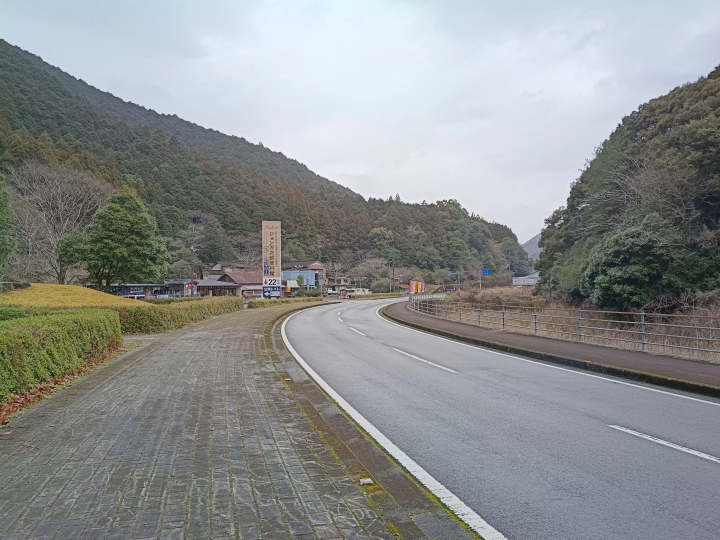
There is a yellow sign with a guide to the John Manjiro Museum.
Landmarks along National Route 321: Road signs (from Shimanto City towards Tosashimizu)
If you are coming from Shimanto City or Kochi City on your way to Cape Ashizuri Misaki, go through the Izu Tunnel and then go about 300m and look for the road sign (straight ahead: Cape Ashizuri Misaki Tatsukushi / turn right: Mihara).
![[ Tosashimizu City, Kochi Prefecture ] How to get to Izu Shrine and important points to note](https://resources.matcha-jp.com/resize/720x2000/2026/03/07-260533.webp)
Landmarks along National Route 321: Kunitachi Park sign and purple "Shinnen-an" sign
Turn right at the intersection with these two signs (turn left if heading towards Shimanto City)
![[ Tosashimizu City, Kochi Prefecture ] How to get to Izu Shrine and important points to note](https://resources.matcha-jp.com/resize/720x2000/2026/03/07-260534.webp)
Follow Prefectural Route 346 (approximately 1 minute, 600m)
This is a two lane road.
About the left turn point on Prefectural Route 346
About 600m ahead you will come across a bridge and a road sign that says " Mihara Village 14km " (although it is faded and difficult to read).
Turn left onto this road.
![[ Tosashimizu City, Kochi Prefecture ] How to get to Izu Shrine and important points to note](https://resources.matcha-jp.com/resize/720x2000/2026/03/07-260535.webp)
Continue on Prefectural Route 346 (approximately 3 minutes, 1.3 km)
Caution: From here on, the road becomes narrower, about 1.5 lanes wide. Please be careful not to drive too fast as it can be dangerous if an oncoming vehicle approaches.
About the entrance (the shimenawa rope on your right is the entrance)
The shimenawa rope on the right is the entrance
![[ Tosashimizu City, Kochi Prefecture ] How to get to Izu Shrine and important points to note](https://resources.matcha-jp.com/resize/720x2000/2026/03/07-260536.webp)
There is a parking space in front, so please park carefully so as not to obstruct traffic on the road.
![[ Tosashimizu City, Kochi Prefecture ] How to get to Izu Shrine and important points to note](https://resources.matcha-jp.com/resize/720x2000/2026/03/07-260537.webp)
There is also a stretch of road with ruts that looks like it could be driven on by car, but it is extremely narrow and it is almost impossible to pass or turn around, so please do not drive on it.
![[ Tosashimizu City, Kochi Prefecture ] How to get to Izu Shrine and important points to note](https://resources.matcha-jp.com/resize/720x2000/2026/03/07-260541.webp)
![[ Tosashimizu City, Kochi Prefecture ] How to get to Izu Shrine and important points to note](https://resources.matcha-jp.com/resize/720x2000/2026/03/07-260539.webp)
There is also a moss-covered stone pillar and a sign indicating that it is a cultural property designated by Tosashimizu City.
Caution: Beware of the wire fence along the approach to the shrine
For a short distance from the entrance, there is a metal fence on the right hand side.
I haven't checked, but there is a warning sign and I think it's probably an electrified fence to keep out pests.
Do not touch it under any circumstances as it may result in electric shock.
![[ Tosashimizu City, Kochi Prefecture ] How to get to Izu Shrine and important points to note](https://resources.matcha-jp.com/resize/720x2000/2026/03/07-260538.webp)
![[ Tosashimizu City, Kochi Prefecture ] How to get to Izu Shrine and important points to note](https://resources.matcha-jp.com/resize/720x2000/2026/03/07-260540.webp)
To the first torii gate (almost Nakama point)
About 300m from the entrance, you will walk through a Mori that is not dense but rather well-maintained.
![[ Tosashimizu City, Kochi Prefecture ] How to get to Izu Shrine and important points to note](https://resources.matcha-jp.com/resize/720x2000/2026/03/07-260542.webp)
Cross a small moss-covered stone bridge.
From here, continue walking with a small stream on your left.
![[ Tosashimizu City, Kochi Prefecture ] How to get to Izu Shrine and important points to note](https://resources.matcha-jp.com/resize/720x2000/2026/03/07-260543.webp)
After crossing this bridge, you will arrive at the First Torii Gate in about one minute.
First Torii Gate - To the sacred grounds of Izu Shrine
Once you pass through the first torii gate, the Mori becomes even deeper and you can hear the cries of various creatures.
Personally, I enjoyed walking while listening to the murmuring of the stream flowing on my left.
![[ Tosashimizu City, Kochi Prefecture ] How to get to Izu Shrine and important points to note](https://resources.matcha-jp.com/resize/720x2000/2026/03/07-260544.webp)
![[ Tosashimizu City, Kochi Prefecture ] How to get to Izu Shrine and important points to note](https://resources.matcha-jp.com/resize/720x2000/2026/03/07-260545.webp)
If you walk about 350m along this approach, you will see a stone bridge with a railing in the Oku.
![[ Tosashimizu City, Kochi Prefecture ] How to get to Izu Shrine and important points to note](https://resources.matcha-jp.com/resize/720x2000/2026/03/07-260546.webp)
Izu Shrine
The stone bridge with railings visible in the Oku of the photo above is the starting point of the stairs leading to the shrine.
![[ Tosashimizu City, Kochi Prefecture ] How to get to Izu Shrine and important points to note](https://resources.matcha-jp.com/resize/720x2000/2026/03/07-260547.webp)
It was raining that day, so we gave up on climbing the slippery, moss-covered stairs.
![[ Tosashimizu City, Kochi Prefecture ] How to get to Izu Shrine and important points to note](https://resources.matcha-jp.com/resize/720x2000/2026/03/07-260548.webp)
Rather than well-maintained concrete stairs, the stairs are slightly irregular and appear to be made from natural stone, covered in moss in places.
This is a very atmospheric climb, but please be careful as there are no handrails or ropes and the stairs are narrow .
It took about 15 minutes to walk slowly from the entrance to the base of the shrine, taking photos along the way.
![[ Tosashimizu City, Kochi Prefecture ] How to get to Izu Shrine and important points to note](https://resources.matcha-jp.com/resize/720x2000/2026/03/07-260549.webp)
Summary and Impressions
Izu Shrine is a historic shrine that has been around for a long time, but it is located in a remote area of Tosashimizu City , so I rarely had the opportunity to visit.However, it is a shrine with a very mysterious atmosphere.
This is a recommended spot for those who love shrines, and also for those who want to take a short walk through a hidden Mori, as the experience of walking the approach path, which takes about 10 to 15 minutes each way, felt more like a stroll but less than a hike, and was very pleasant.
Related articles
![[Tosashimizu City, Kochi Prefecture] Visiting Shrines and Temples (Western Tosashimizu City Part 2)](https://resources.matcha-jp.com/resize/200x2000/2024/04/03-176081.webp)
![[Tosashimizu City, Kochi Prefecture] Visiting Shrines and Temples (Western Tosashimizu City Part 1)](https://resources.matcha-jp.com/resize/200x2000/2024/04/01-175884.webp)
![[Tosashimizu City, Kochi Prefecture] Visiting Shrines and Temples (Ashizuri Peninsula Part 2)](https://resources.matcha-jp.com/resize/200x2000/2024/03/28-175546.webp)
![[Tosashimizu City, Kochi Prefecture] Visiting Shrines and Temples (Ashizuri Peninsula Part 1)](https://resources.matcha-jp.com/resize/200x2000/2024/03/28-175510.webp)
The Hata region of Kochi Prefecture is located at the southwestern tip of Shikoku, and is a peninsula that juts out into the Pacific Ocean, facing Tosa Bay to the east and Bungo Channel to the west. It is made up of three cities, two towns, and one village: Hara Village. It is a natural powerhouse rich in blessings, including the nationally famous Shimanto River and Cape Ashizuri, the blessings of the Kuroshio Current that flows along the coast, and the blessings of mountains that boast the largest area of forests in the country.
The contents on this page may partially contain automatic translation.


![Kansai Airport/Itami Airport/Kobe Airport [Official]](https://resources.matcha-jp.com/resize/100x2000/2023/12/08-155804.webp)
Special Features
More








![[Osaka Sightseeing Bus Tour] Enjoy 360° views of Osaka from an open-top bus!](https://resources.matcha-jp.com/resize/720x2000/2026/05/25-264541.webp)
![[Autumn 2026] Private Night Tour to See the World Heritage Site Toji Temple Illuminated in a Fantastical Light-Up Effect](https://resources.matcha-jp.com/resize/720x2000/2026/04/28-263309.webp)