Okinawa's Shrines and Spirituality: 9 Historical Power Spots

Discover the spiritual side of Okinawa! Beyond the beaches and food, boost your luck at the Eight Ryukyu Shrines. Learn about Naminoue-gu, Futenma-gu, and other unique sacred sites.

Written by
Hailing from Taichung, Taiwan, this woman's eyes light up at the mention of food. Having experienced incredible moments in Japan, she now resides in the Southern Hemisphere, using images and words to record precious memories and discoveries from her travels. She is the author of "Japan, Slow Travel: Encountering Mountain Cities, Floral Seasons, Islands, Seafood, Street Scenes, and Everyday Life, 2190X Seasonal Poems".
This service includes sponsored advertisements.
Discover Okinawa's Spiritual Traditions
Throughout Japan, shrines and temples offer a window into the country's spirituality. Okinawa is no exception, but its local shrines possess unique characteristics found nowhere else in Japan.
For starters, while the rest of the country is home to tens of thousands of shrines, Okinawa has only about 14.
Furthermore, the region follows a specific tradition known as Ryukyu Shinto. This spiritual practice was uniquely shaped by Okinawa’s distinct history and culture, setting it apart from the Shinto traditions seen on the mainland.
Lastly, Okinawa’s history as the Ryukyu Kingdom (1429–1872) played a pivotal role in shaping its spiritual identity.
As a tributary state to the Ming Dynasty, the kingdom maintained close commercial and cultural ties with China during an era when the rest of Japan was largely isolated from the continent. This influence created a culture and spirituality distinct from any other part of Japan.
Visiting these historical shrines offers an opportunity to observe and experience this unique local heritage firsthand.
Shrines in Okinawa
The Eight Shrines of Ryukyu
1. Naminoue Shrine
2. Futenma Shrine
3. Shikina Shrine
4. Asato Hachiman Shrine
5. Sueyoshi Shrine
6. Ameku Shrine
7. Okinogu Shrine
8. Kin-gu Shrine
Miyako Shrine
The Eight Shrines of Ryukyu
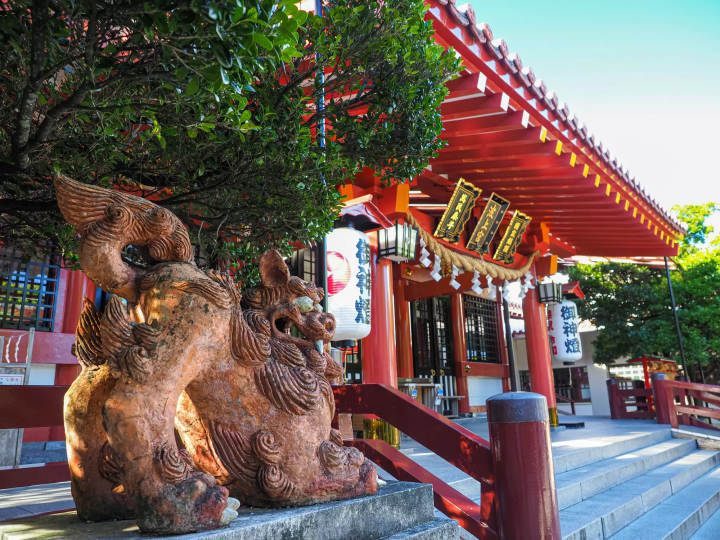
The Eight Shrines of Ryukyu, or Ryukyu Hassha, were a group of sanctuaries under direct control of the royal government during the Ryukyu Kingdom era (1429-1872).
These sacred sites served as the primary locations where the King and the royal family prayed for the peace and prosperity of the realm. It is important to note that these shrines were reserved exclusively for royalty and nobility; they were not accessible to the general public. (Source)
The group consists of:
- Naminoue Shrine
- Okinogu Shrine
- Shikina Shrine
- Sueyoshi Shrine
- Asato Hachiman Shrine
- Ameku Shrine
- Futenma Shrine
- Kin-gu Shrine
Each of these shrines had an adjacent temple providing Buddhist services.
While seven of these shrines are dedicated to the Kumano Gongen deity, which is associated with goddess Izanami, Asato Hachimangu is unique as the only one among them dedicated to Hachiman, the guardian deity of warriors.
1. Naminoue Shrine

Ranked as the most prestigious of the Eight Ryukyu Shrines, Naminoue Shrine is highly revered as the Ichinomiya (the highest-ranking shrine) of the Ryukyu Kingdom.
Perched atop a coastal cliff, the shrine exudes an air of solemn dignity. For centuries, sailors on passing ships have looked up at the sanctuary to pray for safe voyages or to offer thanks for a successful return.
While it was the largest shrine in Okinawa during the Meiji era (1868-1912), the original structure was destroyed by fire during World War II. Following several post-war reconstructions, it was officially designated as a Historical Site and Cultural Heritage of Naha City in 2006.
Located in southern Okinawa, Naminoue Shrine is just a 5-minute drive from Naha’s Kokusai-dori, making it a popular destination for both locals and travelers.
The shrine is dedicated to Izanami-no-Mikoto, the mother goddess of Japanese mythology. Because of this, many visitors come to pray for successful romance, good matches, and safe childbirth.
The shrine is also a favored spot for those seeking blessings for family safety, protection from misfortune, business prosperity, academic success, and longevity.
Naminoue Shrine
Address: 1-25-11 Wakasa, Naha, Okinawa Prefecture
2. Futenma Shrine

Located in Ginowan City, Futenma Shrine is one of the Eight Ryukyu Shrines and the largest sacred site in central Okinawa.
Originally known as Futenma Gongen, the shrine first honored old Ryukyuan Shinto deities—including the Sun, Sea, and Earth gods—within a natural cave. In the mid-15th century, these traditions merged with the worship of Kumano Gongen.
With its iconic orange-red tiled roof, the main hall exudes a traditional Okinawan atmosphere. While visitors traditionally pray here for maritime safety and bountiful harvests, the shrine has recently become a popular destination for construction industry professionals seeking blessings for their projects.
The shrine grounds house the mysterious Futenma-gu Cave, a site steeped in local legend. Visitors can enter the cave for worship free of charge after registering at the Amulet Office (Omamori-juyo-sho). Extending 280 meters, the cave features two entrances and three large chambers.
The interior is characterized by low ceilings and narrow walkways that still bear the marks of ancient water flow. This site is a prehistoric treasure trove: fossils of Ryukyu deer and wild boar dating back 20,000 years were discovered here, alongside artifacts from the late Okinawa Shell Mound period (roughly 3,000 years ago).
A visit offers a rare opportunity to see these precious collections while experiencing the cave's profound, ancient energy. (Note: Photography is strictly prohibited inside the cave.)
Futenma Shrine
Address: 1-27-1 Futenma, Ginowan, Okinawa Prefecture
3. Shikina Shrine

Several legends surround Shikina Shrine. It is said that in a once-desolate wilderness, a mysterious light would shine every night, illuminating the sky between the Big Dipper and Altair.
Following this light, a local high priestess (Oamo) discovered a statue of Binzuru (Pindola Bharadvaja), a disciple of Shakyamuni Buddha, hidden deep within an empty cave. Convinced the light was divine, she began to worship the statue with unwavering faith.
Word of the statue spread as miraculous healings occurred. When the eldest son of King Sho Gen fell ill, the priestess encouraged the prince to pray to Binzuru; he did, and he made a full recovery.
In gratitude, the prince used his own wealth to establish Shikina Shrine and an adjacent temple. He even built a home for the priestess so she could remain the shrine's guardian. By 1644, it became a royal tradition for the King to visit Shikina-gu on auspicious days in January, May, and September of each year.
Originally, the sanctuary of Shikina-gu was housed inside the cave. However, because high humidity caused the structure to decay and made repairs difficult, it was moved outdoors in 1680. The current building maintains a traditional Okinawan aesthetic with its vibrant red-tiled roof.
If you walk past the main hall, you will find the entrance to the Shikina-gu Cave. The cave is open to the public only on the 1st and 15th of every month, so if you're curious to see the interior, be sure to plan your visit on one of those specific dates.
Shikina Shrine
Address: 4-1-43 Hantagawa, Naha, Okinawa Prefecture
4. Asato Hachiman Shrine

Established in 1466, Asato Hachiman Shrine is the oldest of the Eight Ryukyu Shrines. It enshrines the Hachiman deities: Emperor Ojin, Tamayori-hime no Mikoto, and Empress Jingu. Unlike the other seven shrines, which are mostly rooted in cave legends, Asato Hachiman-gu is defined by a tale of military conquest.
According to legend, the brave King Sho Toku led an expedition to Kikai Island. While passing through Asato, he raised his bow and made a vow: "If I can strike down a bird in flight with a single arrow, grant me the power to pacify Kikai Island." He successfully shot the bird down. Later, as his fleet departed Naha Port, a Buddhist bell appeared floating on the sea alongside his ship.
Convinced this was a sacred gift from Hachiman Daibosatsu and a guarantee of victory, the King secured the bell and went on to successfully conquer Kikai Island. To fulfill his vow, he established Asato Hachiman Shrine at the site where he fired the arrow and built the nearby Komyozan Shintokuji temple to house the miraculous bell.
Unfortunately, Asato Hachiman Shrine was destroyed by fire during the Battle of Okinawa. It took decades to begin the recovery process; the "Hachiman-gu Restoration Committee was finally established in 1993, fulfilling the long-held community dream of rebuilding the shrine. Today, many visitors come to this historic site specifically to pray for success and victory in their endeavors.
Asato Hachiman Shrine
Address: 3-19-14 Asato, Naha, Okinawa Prefecture
5. Sueyoshi Shrine

Sueyoshi Shrine originally comprised a main hall (honden), a worship hall (haiden), and a ritual stage. Although the worship hall collapsed during the late Meiji period, the surviving main hall and ritual stage remain perched atop separate bedrock outcrops, connected by a unique stone arch bridge and stone staircases.
While the shrine did not escape the devastation of World War II, the current structure was meticulously reconstructed using salvaged materials from the original site.
The sanctuary features a "stilt-style" (takayuka) construction reminiscent of the famous stage at Kyoto’s Kiyomizu-dera. From a distance, it appears to float above the lush green canopy.
To reach it, visitors must navigate winding stone paths beneath the structure and climb steep tiers of steps—an experience so striking that many consider Sueyoshi-gu the most memorable of the Eight Ryukyu Shrines.
Sueyoshi Shrine
Address: 1-8 Shuri Sueyoshi-cho, Naha, Okinawa Prefecture
6. Ameku Shrine

Built in the late 15th century, Ameku Shrine in Naha City is famous for its legend involving a man named Mekaru Okonshi.
He witnessed a noblewoman and a priest vanish into a mountainside cave; when the King’s ministers investigated, incense placed at the site miraculously ignited on its own. The woman was later revealed to be Benzaiten, the guardian deity of the arts.
Architecturally unique, the shrine features a three-story layout built into a slope. Visitors enter near the Utaki (sacred site) by the parking lot, then descend stairs to reach the worship hall and main sanctuary.
Benzaiten is enshrined here as a patron of the arts, maritime safety, and matchmaking, making it a popular spot for those seeking to end bad relationships and find true love.
Ameku Shrine
Address: 3-19-3 Tomari, Naha, Okinawa Prefecture
7. Okinogu Shrine

Okinogu Shrine traces its origins to a piece of sacred driftwood discovered in Naha Port after a mysterious glow was reported. According to the 1713 Ryukyu-koku Yuraiki, the King of Ryukyu enshrined the "divine tree" as a guardian of maritime safety.
Originally located at the port, the shrine was moved in 1908 for harbor construction. Although its main hall was designated a national treasure in 1938, it was destroyed during World War II.
After several post-war relocations, it finally settled in Naha’s Onoyama Park, a scenic area famously depicted by artist Katsushika Hokusai as one of the "Eight Views of the Ryukyu Islands."
The shrine's spiritual heart is the Tentoshan Utaki, where the sun goddess Amaterasu Omikami is enshrined to protect the nation and ensure bountiful harvests. Because the grounds feature numerous prayer spots for different deities, it is recommended to use the shrine’s map to plan an efficient worship route.
Okinogu Shrine
Address: 44 Onoyama-cho, Naha, Okinawa Prefecture
8. Kin-gu Shrine

Located in central Okinawa, Kin-gu is the only one of the Eight Ryukyu Shrines to survive the war with its ancient architecture intact. The grounds are home to a 350-year-old sacred tree and the remarkable Nisshu-do limestone cave.
The shrine’s history began when the monk Nisshu Shonin, after training at Mount Koya, founded the Kin Kannon-ji Temple and established Kin-gu within the cave.
Despite the Meiji-era decree to separate Shintoism and Buddhism, Kin-gu Shrine preserved its tradition of Shinbutsu-shugo (the syncretism of both faiths). Today, the coexistence of the temple and shrine stands as a rare and enduring testament to the region's unique religious heritage.

A chilling legend haunts the limestone cave of Kin-gu: a giant serpent once lived there, transforming into a handsome man to lure and devour local maidens. Peace was only restored when the monk Nisshu Shonin sealed the beast away.
Whether or not you believe the lore, a visit to the 270-meter-long Nisshudo Cave behind the main hall is essential. Its surreal stalactites and profound silence offer a mysterious spiritual experience unlike any other shrine in Japan.
Kin-gu Shrine
Address: 222 Kin, Kin-cho, Kunigami, Okinawa Prefecture
Miyako Shrine

Located in Miyakojima, Miyako Shrine holds the distinction of being the southernmost shrine in Japan. It enshrines the three Kumano deities—transferred from Naminoue Shrine—alongside the three Toyomiya deities, the historical rulers of Miyako Island.
The shrine is a popular destination for those seeking blessings for financial fortune and business success.
The architecture is rich in local character, featuring a vibrant red-tiled roof flanked by guardian Komainu statues. This iconic imagery is beautifully captured on the shrine's official Goshuin-cho (stamp book), making it a must-have souvenir for collectors visiting this unique geographic landmark.
The shrine’s cultural heart is its annual festival on October 26. During this event, locals in traditional attire perform the "Ooyasakae" and the "Lion Dance" (Shishi-mai) to pray for bountiful harvests and protection from misfortune.
Miyako Shrine
Address: 5-1 Hirara Nishisato, Miyakojima, Okinawa Prefecture
Explore Okinawa's Shrines
Okinawa’s shrines offer a profound sense of mystery, revealing the region’s complex history through a blend of unique natural landscapes and local legends.
If you have the chance to visit, consider stopping by these sacred sites to experience the vibrant, abundant energy they provide.



Hailing from Taichung, Taiwan, this woman's eyes light up at the mention of food. Having experienced incredible moments in Japan, she now resides in the Southern Hemisphere, using images and words to record precious memories and discoveries from her travels. She is the author of "Japan, Slow Travel: Encountering Mountain Cities, Floral Seasons, Islands, Seafood, Street Scenes, and Everyday Life, 2190X Seasonal Poems".



Special Features
More